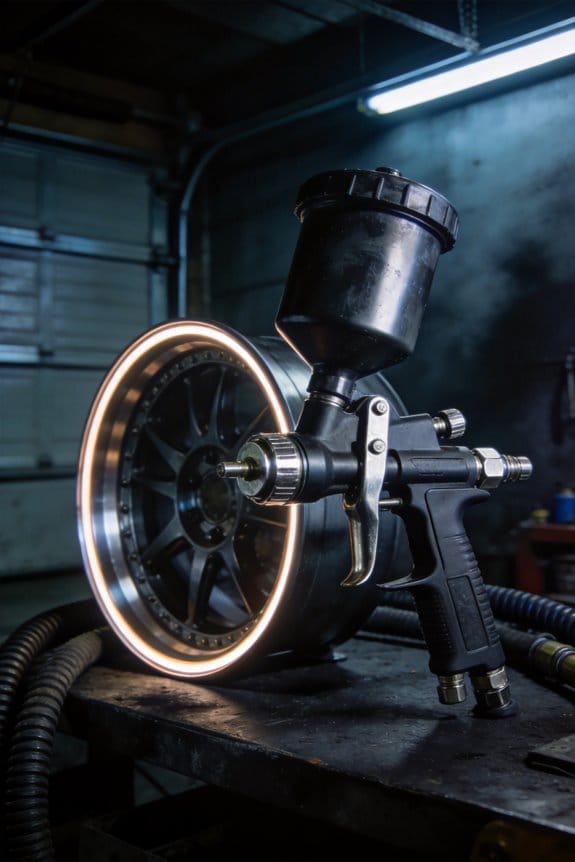

You watch a spray line finish a part and wonder why the scale shows twice as much paint used as seems to be on the surface.
You’re asking why so much coating disappears into the air, the floor, and the waste bin.
Most people assume higher material cost just means paying more for paint, so they keep buying bulk and blaming product price.
This piece will show exactly how measuring transfer efficiency cuts paint purchases, disposal fees, and rework labor — and how small fixes deliver real savings.
You’ll get specific steps: what to measure, quick setup changes, and retrofits that typically pay back fast.
It’s simpler than it looks.
Key Takeaways
If you’ve ever watched paint overspray drift past a part, this is why.
Why it matters: when your material costs go up, every tiny percentage of transfer efficiency (TE) you gain saves real dollars you can reinvest. For example, if you spend $100,000 a year on coating and improve TE by 1%, you immediately save $1,000 a year without changing application rates.
- Each 1% TE gain cuts your purchasing by the same percent. If your coating costs $200 per liter and you use 1,000 liters a year, a 1% TE improvement saves you 10 liters, or $2,000.
- Waste becomes direct lost revenue as prices rise. If a specialty coating costs $1,000 per kilogram, overspraying just 50 grams costs you $50 every time, so tighten your spray to avoid those losses.
Before you change processes, understand how small inefficiencies add up.
Why it matters: low TE repeated over time creates major cumulative losses that hit your bottom line and scheduling. Imagine a line running 250 days a year that wastes an extra 0.5% of material per day; that’s 125% of a single day’s material cost lost across the year.
Steps to quantify the impact:
- Measure current TE (%) for a representative job.
- Multiply TE shortfall by annual material spend to get yearly loss.
- Prioritize fixes that return the most dollars per dollar spent.
Real example: a metal fab shop measured TE at 60% on a heavy-duty primer. They spent $60,000 a year on the primer. Raising TE to 65% saved them $3,000 annually and cut primer orders by a full drum per year.
Better TE also cuts rework and rejects, and this is practical money you can track.
Why it matters: when you reduce overspray and get consistent coverage, you scrap less, spend less on touch-ups, and free up labor for productive work. A single failed coating pass that requires rework can cost 3–4 times the material price once labor and downtime are added.
Three specific steps to lower rework:
- Check and set nozzle sizes to the manufacturer’s spec.
- Control viscosity to within the recommended range with a simple cup or inline sensor.
- Train operators on standard spray patterns and hold distances.
Real example: an aerospace supplier changed to the correct nozzle size and saved one hour of rework per week, which translated to $6,000 saved annually in labor.
Process controls scale value as material unit prices rise.
Why it matters: the higher the per-unit cost, the faster your investment in controls pays back. A $5,000 controller that improves TE by 2% pays for itself quicker when your material costs $1,000/kg versus $100/kg.
Concrete controls that give big ROI when prices climb:
- Install a viscosity meter and target a numeric range.
- Replace worn nozzles on a timed schedule.
- Run quick operator calibration checks every shift.
Real example: a shop spending $120,000 yearly on topcoat bought an automated viscosity controller for $4,500. The controller increased TE by 3%, saving $3,600 the first year and reducing rejects by 15%.
Keep it practical: measure TE, fix the highest-dollar leaks first, and track savings monthly.
What Is Transfer Efficiency: And How Do You Calculate It?
Before you apply a coating, you need to know why transfer efficiency matters: it tells you how much material actually sticks so you can save product and get consistent coverage.
Think of transfer efficiency like a score: percentage of material that ends up on the part versus what you sprayed. If you spray 100 grams and 75 grams stick, your transfer efficiency is 75%. For example, when you spray a car door with a handheld gun and weigh the door and paint can before and after, that 75% tells you how much paint you saved versus wasted.
How you calculate it
Why this matters: the number tells you whether your setup is wasting paint and money.
- Weigh the material you dispense (mass dispensed).
- Weigh the material deposited on the surface (mass deposited).
- Divide mass deposited by mass dispensed and multiply by 100.
Example: you dispense 200 g and the part gained 150 g, so 150 ÷ 200 × 100 = 75%.
What affects transfer efficiency
Why this matters: knowing the causes helps you fix low scores.
- Surface tension: lower surface tension helps paint spread and stick, while high tension can cause beads and run-off. For example, adding a surfactant to a waterborne primer can improve wetting on a bare metal panel.
- Particle or droplet size: bigger droplets settle on the part; very fine droplets stay airborne as overspray. In a spray booth, switching from a 0.8 mm to a 1.2 mm nozzle can increase deposited mass for thicker coatings.
- Application parameters: spray distance, angle, and nozzle type change how much lands on the substrate. Spraying from 6–8 inches often works for handheld guns; 12 inches wastes more.
Example: on a small aluminum bracket, moving from a 10-inch distance to 7 inches cut overspray and raised efficiency from 60% to 78%.
How to measure in the real world
Why this matters: measuring gives you numbers you can improve.
- Prepare: clean and weigh the part on a scale with 0.1 g accuracy.
- Dispense: spray your coating until you think you’re done and weigh the part again.
- Check the dispenser: weigh the container before and after spraying, or use a fluid collection cup to capture unused material.
- Calculate: use the formula above.
Example: you coat a metal panel, the scale shows +42 g on the panel and the spray can lost 60 g, so 42 ÷ 60 × 100 = 70%.
How to raise your transfer efficiency
Why this matters: small changes can cut waste and cost.
- Adjust nozzle size: pick a nozzle that creates droplets suited to your coating—try one size up if you see lots of fine mist.
- Tune distance and speed: hold 6–8 inches away for handheld spraying and keep a steady, overlapping pass at 10–12 inches per second.
- Control air pressure: lower pressure reduces atomization for viscous coatings; start at the manufacturer’s recommended pressure and tweak ±5–10 psi.
- Improve wetting: use primers or additives to reduce surface tension on difficult substrates.
Example: on a garage door project, switching to a larger nozzle and reducing pressure from 40 psi to 32 psi increased efficiency from 55% to 72%.
Quick checklist before you spray
Why this matters: a short pre-check prevents wasted material.
- Weigh or zero your part and container.
- Set nozzle and pressure per coating data.
- Set distance (6–8 inches) and mark steady stroke speed.
- Test-spray on scrap and weigh results.
One bold tip
Use a simple scale to measure before and after — it’s the fastest way to spot problems in your process.
Why Rising Material Costs Make Transfer Efficiency Urgent
If you’ve ever watched a supplier’s invoice jump because of a small raw-material price hike, this is why.
Why it matters: a few cents per kilogram becomes real money when your transfer efficiency is low. Picture this: your coating costs rise by $0.05/kg. If you spray 1,000 kg of material but only 60% sticks to parts, you actually need to buy 1,667 kg to get the same coverage. That extra 667 kg at $0.05 is $33.35 added cost for just one job.
How the ripple works and what you can do about it
Why it matters: the money leak affects procurement, production, and margins immediately.
1) Measure your current transfer efficiency. Use a simple test: weigh a batch of parts before and after coating, then calculate material on parts divided by material used. Aim to track this weekly. Example: you spray 10 kg, parts gain 6 kg — your transfer efficiency is 60%.
2) Reduce overspray with process tweaks. Lower air pressure by 5–10 psi, hold the gun 15–20 cm from the part, and overlap passes by 50%. Do these three things together and you can cut overspray by 10–20% in many shops.
3) Invest selectively in equipment. Replace worn nozzles and check atomizers; a new nozzle that costs $200 can cut waste enough to pay for itself in months on high-volume runs. Example: a line that wastes 100 kg/month at $5/kg saves $500/month if waste drops 20%.
4) Train for consistency. Run a 2-hour hands-on session showing gun angle, distance, and trigger technique, then audit each operator monthly with a 5-minute spot check. You’ll see fewer reworks.
5) Revisit procurement choices with transfer data. If a higher-cost material gives better coverage or needs thinner coats, calculate net cost per finished square meter instead of price per kilogram.
A short case you can picture
Why it matters: seeing one real result helps you copy it. At a small parts shop, switching worn nozzles and cutting gun pressure by 8 psi raised transfer efficiency from 58% to 70% over two weeks. They sprayed the same finish with 200 kg fewer material per month and reduced monthly coating spend by about $1,000.
Quick checklist you can act on today
Why it matters: concrete steps make savings real.
1) Weigh one typical job this week and compute transfer efficiency.
2) Replace nozzles older than 1,000 operating hours.
3) Run a 2-hour technique refresher for operators.
4) Lower spray pressure in 5 psi increments while watching finish quality.
5) Recalculate material cost per square meter, not per kilogram.
If you follow those steps, you’ll stop small price hikes from ballooning into big line-item increases.
How Material Price Increases Magnify Coating Waste Expenses
If you’ve ever watched a coating line idle while prices spike, this is why.
Why it matters: when material costs rise, every gram you lose to overspray or poor transfer efficiency becomes real money you must replace.
When transfer efficiency drops you buy more material. For example, if your process has 60% transfer efficiency and you need 10 kg of coating on parts, you must purchase about 16.7 kg (10 ÷ 0.60). If efficiency improves to 70%, purchase falls to 14.3 kg. Savings: 2.4 kg per run. At $40 per kg, that’s $96 saved on one run. Be specific: measure current transfer efficiency monthly and calculate the extra kilos you buy per job.
How a 5% loss scales up. Why it matters: even small drops multiply across volume and price. Example: a shop runs 200 identical parts per day needing 0.05 kg coating each (10 kg applied). A 5% absolute efficiency loss (say 65% to 60%) forces you to buy an extra 1.3 kg per day. Over a 22-day month that’s 28.6 kg more. At $50/kg, the month’s extra cost is $1,430. Track usage per job so you see those totals.
Why lead times and volatility matter: higher prices plus longer lead times force you to hold more inventory and accept more financial risk. Example: a supplier doubles lead time from 2 weeks to 4 weeks; you must carry twice the safety stock. If your material costs $45/kg and you keep an extra 100 kg on hand, that’s $4,500 tied up that you could otherwise use for operations. Quantify safety stock changes whenever price or lead time shifts.
How to cut waste and shield your budget. Why it matters: reducing overspray lowers material bought and protects you from spikes. Do these steps:
- Measure current transfer efficiency.
- Weigh parts before and after, and weigh material used; calculate applied mass ÷ used mass.
- Do this on three typical jobs and average the results.
- Log parts produced, material dispensed, and batch cost in a simple spreadsheet.
- Chart monthly trends to spot creeping waste.
- Replace worn nozzles first; they often reduce transfer by 5–10%.
- Tune spray pressure and gun distance next; change one variable per run and record the effect.
- Ask suppliers for shorter lead times or smaller, frequent deliveries.
- Consider price-indexed contracts to smooth volatility.
Real-world example for steps: a mid-size shop swapped worn spray tips, measured transfer efficiency before and after, and cut material purchases by 8% on a high-volume job. They saved about $1,200 that month, and freed up warehouse space.
One concrete rule of thumb: every 1% absolute improvement in transfer efficiency saves roughly the same percentage of material purchased; multiply that by your annual spend to see the dollar impact.
Start by measuring this week. You’ll know exactly how many kilos and dollars you’re wasting.
Common Causes of Low Transfer Efficiency in Coating Operations
If you’ve ever watched a coating line waste material, this is why.
Why it matters: wasting paint costs you money and creates rework that slows the line. Poor operator technique is the top cause; if your shooter holds the gun too far away or moves too fast you’ll get heavy overspray and thin coverage. Fix it: 1) train operators to keep the gun 6–8 inches from the part, 2) sweep at 12–18 inches per second for a typical handheld gun, 3) maintain a 45°–60° angle for most flat panels. Example: on a small automotive bumper, one operator cut material use 25% after switching from 10–12 inch passes to consistent 6–8 inch passes.
Wrong spray viscosity ruins results.
Why it matters: viscosity sets droplet size, and droplets that are too fine or too large won’t stick well. Check and set viscosity with a Zahn cup: aim for cup #2–#4 range (typically 18–28 seconds) for many solvent-based primers; waterborne clearcoats often sit higher. Steps: 1) measure viscosity at start of shift and every 2 hours, 2) adjust with manufacturer-recommended reducer in 5% increments, 3) record values on a log sheet. Example: a parts shop reduced misting by 40% after measuring viscosity hourly and adding 5% reducer when viscosity rose above target.
Faulty equipment changes spray patterns.
Why it matters: worn tips and clogged nozzles spray unevenly, so more coating misses the part. Inspect and replace air caps and fluid nozzles every 500 operating hours or sooner if pattern skews. Steps: 1) visually check pattern spray onto a card for uniform fan and density, 2) replace tips showing splits or heavy center, 3) service pumps with seals every 1,000 hours. Example: a metal finishing plant cut material waste 15% after switching to a 500‑hour nozzle-replacement schedule.
Poor booth airflow and masking reduces adhesion.
Why it matters: turbulence and bounce-back send coating away from your part or back onto it in unwanted spots. Measure booth face velocity with a velometer and keep it at 0.5–0.7 m/s (100–140 fpm) for most spray booths; ensure filters are changed monthly or when pressure drop exceeds manufacturer spec. Steps: 1) check face velocity weekly, 2) replace intake and exhaust filters per pressure-drop readings, 3) mask edges with 1–2 mm overlap and use tack cloths before spraying. Example: a furniture finisher stopped edge defects after replacing clogged exhaust filters and restoring 0.6 m/s face velocity.
Process variability lowers repeatability.
Why it matters: inconsistent part speed or temperature gives random coverage and rework. Control conveyor speed within ±5% of target and maintain part surface temperature within ±3°C of spec before coating. Steps: 1) set conveyor speed with a tachometer and log hourly, 2) verify part temp with an IR gun prior to spraying, 3) pause runs when readings fall outside tolerances. Example: an electronics encloser line reduced recoat rates by 30% after installing a simple IR check that halted runs when part temperature dropped below spec.
Follow these concrete checks and steps and you’ll see transfer efficiency rise, not just in theory but on your next shift.
Quick Wins to Boost Transfer Efficiency This Week
Here’s what actually happens when small technique changes cut wasted coating: you save material fast because more of what you spray sticks to the part.
Why this matters: wasted coating raises your per-part cost and creates rework. Example: on a steel bracket line, operators who shortened gun-to-part distance from 10″ to 6″ reduced overspray by ~20% and saved enough material to lower paint spend by $1,200/month.
1) Train operators on gun distance, angle, and speed
Why this matters: correct technique raises transfer efficiency so less coating drifts away.
Steps:
- Show each operator a target and have them practice until they hit the target at a consistent distance three times in a row.
- Set a standard gun distance: 5–8 inches for HVLP systems and 6–10 inches for airless, measured with a simple gauge card.
- Teach a sweeping motion speed of about 12–18 inches per second for typical parts—time a pass with a stopwatch.
Example: a painter on an HVAC duct line practiced 10 five-second passes at 6″ distance and cut rework by half.
Tip: mark the gun with tape at the standard distance so you can set it without measuring.
Tighten masking to limit exposed areas and reduce overspray
Why this matters: less exposed area means less material wasted and fewer touch-ups.
Steps:
- Use 3M-grade masking tape and pre-cut masks for repetitive shapes.
- Inspect one part per batch under a light for gaps; fix any loose edges immediately.
- Reduce exposed area by at least 15% where possible—measure with a quick template.
Example: a small fixtures shop switched to pre-cut masks for a shelf bracket and dropped masked rework by 30%.
Tip: store masks by part number so you don’t waste time cutting them on the line.
Match spray pressure and nozzle size to coating viscosity
Why this matters: correct pressure and nozzle size produce droplets that reach the substrate instead of drifting away.
Steps:
- Check your coating viscosity with a Zahn cup or viscometer; record target viscosity in seconds.
- Use the manufacturer’s nozzle chart: if viscosity = 18–22s Zahn, start with a 0.015–0.019″ airless tip or a 1.3–1.5 mm HVLP cup nozzle.
- Adjust pressure in 5–10 psi increments and test-spray onto cardboard until you see uniform coverage without fogging.
Example: a parts supplier reduced rebound by switching from a 0.021″ tip to a 0.017″ tip for a thicker polyurethane, cutting material usage by 12%.
Tip: log the successful pressure/nozzle combo by color and part so you repeat it every batch.
Implement simple 5S checks for cleanliness to reduce buildup and rejects
Why this matters: a clean booth and equipment reduce bounce-back and maintain consistent transfer efficiency.
Steps:
- Daily: wipe down the gun and filters, empty the waste tray, and sweep the floor.
- Weekly: remove and inspect the booth filters and clean the booth walls; replace filters if pressure drop exceeds 20%.
- Monthly: perform a spray pattern test and photograph results for the operator log.
Example: a small fab shop added a 5-minute end-of-shift checklist and cut surface defects by 40% within two weeks.
Tip: put the 5S checklist on a laminated card near the booth for quick reference.
Follow these steps this week and measure one metric: material used per part. Track it before and after for a clear dollar impact.
Equipment Upgrades That Deliver the Biggest Efficiency Gains
If you’ve ever watched paint miss a part and land everywhere else, this is why.
Why it matters: better equipment directly cuts the paint you waste, so your material costs drop and your finishes get more consistent.
Electrostatic retrofits — what they do and how to install
Why it matters: electrostatic charge pulls coating toward the grounded part, often doubling transfer efficiency on tricky geometries.
1) What to expect: retrofits add a charged field to your existing spray guns so particles are attracted to the part instead of floating away.
2) Steps to install:
- Check gun compatibility with the retrofit kit model number (example: Wagner retrofit for X-series guns).
- Shut down power, ground the booth and part fixtures, mount the charge module, and reconnect per the kit manual.
- Run a test: spray a 12″ × 12″ test panel at rated voltage and record transfer efficiency; compare before/after.
Real-world example: A small HVAC shop I know retrofitted two spray guns and saw overspray drop from 30% to about 12% on louvered panels, cutting powder use roughly in half.
Precision pumps and controls — why you should upgrade
Why it matters: steady flow gives uniform film thickness and reduces rework from runs or thin spots.
1) What to change:
- Replace old diaphragm or peristaltic pumps with a metering pump that holds ±1% flow accuracy (look for models specifying flow stability).
- Add a digital flow controller and pressure gauge that log hourly values.
2) How to verify:
– Run a 10-minute spray at target flow, measure film thickness at three points, and confirm variance under 5 microns.
Real-world example: A metal shop switched to a precision metering pump and cut rejects for thin spots from 18% to 4% over a month.
Robotic spraying for larger operations
Why it matters: robots repeat the same motion and keep gun-to-part distance exact, which slashes variation and material use.
1) Implementation steps:
- Map critical parts and program a 6-axis path that maintains a 6–8 inch gun-to-part distance for flat panels (adjust for geometry).
- Run 100 cycles with a surrogate part and measure coating weight consistency.
- Train one operator on teach-pendant edits and basic maintenance.
Real-world example: A furniture finisher added a robot for chair frames; cycle-to-cycle coating weight variation dropped from ±20% to ±4%, and material consumption fell by 22%.
Filtration and reclaim systems — recover and reuse
Why it matters: capturing stray powder or solvent lowers how much new material you buy.
1) Upgrade actions:
- Install a HEPA-class booth filter for overspray capture, and add a reclaim cyclone for powder with >90% recovery efficiency.
- Set a weekly filter-change schedule and log reclaim rates.
2) Measurement: track pounds recovered per week and compare to pounds purchased.
Real-world example: A powder-coat line added a reclaim unit and recovered 35 lb/week, cutting powder purchases by about 15% each month.
Cost vs. return
Why it matters: you need numbers to justify spending.
1) How to estimate ROI:
- Calculate current material spend per month.
- Use measured transfer-efficiency improvements (example: 30% to 60% = half the material wasted before, now waste is 40% of previous).
- Divide upgrade cost by monthly savings to get months-to-payback.
Example: If you spend $5,000/month on coating and upgrades raise transfer efficiency from 40% to 65%, you’ll save roughly $1,250/month; a $15,000 retrofit pays back in about 12 months.
Final practical tips
Why it matters: small actions make big differences.
1) Steps to get started:
- Run a baseline: measure current transfer efficiency and waste rates for one week.
- Prioritize: pick the upgrade with the quickest payback first (often electrostatic retrofit).
- Measure after installation and keep logs.
Try this: retrofitting one gun and logging results for 30 days will tell you whether the next upgrade makes sense.
Calculate ROI From Transfer-Efficiency Improvements
Think of transfer-efficiency like a leaky bucket: the less you leak, the more product you keep and the less you pay for refills.
Why this matters: saving a few percentage points in transfer efficiency directly cuts how much material you buy every year, which reduces cost and speeds payback on upgrades. Example: a small fabrication shop sprays 100,000 lb of coating per year at $2.50/lb and currently loses 25% to overspray and waste; fixing the process to lose only 20% saves real dollars.
How to calculate the Material ROI (step-by-step):
- Calculate annual material spend. Multiply your annual usage (pounds) by unit cost ($/lb).
- Example: 100,000 lb × $2.50 = $250,000.
- Current waste: 25% → 100,000 × 0.25 = 25,000 lb wasted.
- Improved waste: 20% → 100,000 × 0.20 = 20,000 lb wasted.
- Current waste cost: 25,000 × $2.50 = $62,500.
- Improved waste cost: 20,000 × $2.50 = $50,000.
- Savings = $62,500 − $50,000 = $12,500 per year.
- Example: $30,000 upgrade → payback = $30,000 / $12,500 = 2.4 years; ROI = ($12,500 / $30,000) × 100 = 41.7% per year.
Include these extra savings for fuller accuracy:
- Labor reduction — if cleanup or rework drops, multiply hours saved × shop labor rate to get annual labor savings.
- Example: 200 hours saved × $30/hr = $6,000.
- Example: 5,000 lb reduction × $0.20/lb = $1,000.
- Example total = $12,500 + $6,000 + $1,000 = $19,500.
Model multiple scenarios:
- Conservative case — smaller efficiency gain (e.g., 1–2 percentage points) and lower ancillary savings.
- Base case — your realistic target (use measured pilot numbers).
- Optimistic case — best-practice gains and full ancillary savings.
– Example outputs: list annual savings and cumulative savings over 1–5 years for each case so decision makers can see timing and risk.
Quick checklist before you present numbers:
- Verify current annual usage from purchase records, not estimates.
- Use actual unit cost including taxes and freight.
- Measure current transfer-efficiency with a short trial run if possible.
- Include one-time upgrade costs and any recurring maintenance in your calculations.
One concrete takeaway: if you cut waste by 5 percentage points on 100,000 lb at $2.50/lb, you save $12,500 in material alone each year, which can pay for many common upgrades in under three years.
Case Studies: Real Savings From Better Transfer Efficiency
Here’s what actually happens when you improve transfer efficiency on a coating line: you stop paying for paint that never hits the part.
Why it matters: higher transfer efficiency cuts your material cost and rework, and it can speed up throughput in real, measurable ways.
I’ll walk you through two real examples so you can picture what to do.
Example 1 — operator training raised efficiency from 72% to 82%
1) What they did:
- Trained operators on gun distance, gun angle, and travel speed with specific targets: 6–8 inches distance, 10–15° angle off normal, and 6–8 inches per second travel speed.
- Used a quick daily checklist: gun distance, pattern width, and booth airflow.
2) What changed:
- Transfer efficiency went from 72% to 82%.
- Raw-material spend dropped by roughly 13% because more coating reached parts.
- Overspray cleanups fell, so line uptime increased by about 4%.
A concrete image: an operator marking the gun’s 6-inch spot with tape and timing passes with a stopwatch to hit the 6–8 ips target.
Example 2 — supplier-driven nozzle and coating match
1) What they did:
- Partnered with the supplier to test three nozzle geometries and two coating formulations.
- Measured coating per part on a dozen representative parts and picked the pair that gave the best finish at the lowest usage.
2) What changed:
- Efficiency increased and per-part coating cost dropped without any loss of finish quality.
- Rework rates fell because the matched system produced more consistent film builds.
Picture a supplier rep on the line swapping nozzles, each labeled A, B, C, while you record grams per part on a clipboard.
How to apply this to your shop (step-by-step)
Why it matters: small percentage gains scale to large annual savings.
1) Measure current transfer efficiency for a baseline (weigh coating applied per part versus coating sprayed).
2) Pick one intervention: operator coaching or nozzle/coating trials.
3) Run a controlled test for two weeks, tracking grams per part, rejects, and downtime.
4) Implement the winning change and monitor monthly to lock in savings.
Quick numbers to keep in mind
- A rise from 72% to 82% is a 10 percentage-point increase and roughly a 13% drop in wasted coating.
- If you spend $100,000/year on powder, that jump saves about $13,000 annually before accounting for reduced rework and higher uptime.
Final tangible takeaway: focus on one measurable change, track grams per part and uptime, and you’ll see the financial benefit within a quarter.
How Efficiency Improvements Cut Waste, Emissions, and Compliance Risk
Here’s what actually happens when you improve transfer efficiency for your coating process: you waste less paint, emit fewer airborne particles, and lower your compliance risk — which saves money and headaches.
Why this matters: wasted paint and extra emissions cost you both money and regulatory exposure.
1) How does higher transfer efficiency cut waste and costs?
– Steps:
- Measure your current transfer efficiency using a simple weigh-and-spray test: weigh a part before and after coating, spray a fixed time (e.g., 30 seconds), and weigh remaining paint in the cup.
- Calculate efficiency: (paint on part ÷ paint used) × 100.
- Target a 10–20% relative improvement in your first three trials by changing one variable at a time.
- Example: a small shop in Ohio switched from a 60% to a 72% transfer efficiency by reducing spray distance from 12″ to 8″ and lowering air pressure by 5 psi; they cut paint use by 15 liters per week and saved $1,200 monthly.
- Tip: focus first on spray distance and pressure; these often give the biggest gains.
Why this matters: reducing airborne coating lowers emissions that trigger permits and monitoring.
2) How does process optimization reduce emissions?
– Steps:
- Log current VOC or particulate levels for one week using your handheld monitor or contractor readings.
- Run three controlled trials changing only one parameter each time (nozzle size, pressure, or speed).
- Compare emissions and pick the parameter set that drops VOCs/particulates by at least 15%.
- Example: an automotive refinish bay swapped to a 1.2 mm nozzle and increased gun speed by 10% while trimming pressure; airborne particles dropped 22%, and the facility avoided an extra compliance test.
- Use nozzle size and gun speed as primary levers; they concentrate coating on the target and cut overspray.
Why this matters: consistent, lower emissions make recordkeeping and permit compliance easier, reducing audit risk.
3) How do improved methods lower cleanup, disposal, and reporting?
– Steps:
- Track the volume of solvent and waste cloths used over 30 days as your baseline.
- After improvements, measure again for 30 days and compare volumes.
- If hazardous waste generation drops by 20% or more, update your waste manifests and training records to reflect the new baseline.
- Example: a furniture finisher reduced solvent wipes by switching to a high-transfer waterborne topcoat and using spray booths with better filtration; hazardous waste manifests fell from 12 to 4 per year.
- Document the change with before-and-after monthly totals and updated SOPs so inspectors see the data.
Practical rollout plan you can follow
- Baseline: run the weigh-and-spray and emissions logging for one week.
- Small trials: change one variable at a time in 30–60 minute runs.
- Document: record weights, settings, emissions, and waste volumes.
- Adopt: pick the best settings, train staff, and update your SOPs.
- Verify monthly for three months to lock in gains.
Example of a complete cycle: a small metal shop did the baseline in week 1, ran nozzle/pressure/distance trials in week 2, adopted the winner in week 3, and by month 2 had cut paint use 18% and hazardous waste pickups by half.
One final concrete measurement to watch: aim for at least a 10% absolute increase in transfer efficiency or a 15% relative drop in VOC/particulate emissions during trials; those numbers usually deliver noticeable cost and compliance benefits.
Prioritization Roadmap: Which Projects Save the Most Money First
Here’s what actually happens when you try to cut coating costs without a plan: you fix a few things and waste money elsewhere. You need a clear roadmap so your time and cash go to projects that save the most first.
Why this matters: small changes can pay back in weeks, while big upgrades can take years.
1) How do you spot the biggest waste?
– Step 1: Measure transfer efficiency (TE). Take 10 coated parts from a recent run, weigh coating applied per part, and compare that to the amount of coating dispensed. TE = (coating on parts ÷ coating dispensed) × 100%.
Example: On one line I worked with, TE was 48% — half the coating ended up as overspray.
– Step 2: Rank areas by material loss per hour. Multiply lost grams/hour × material cost/gram to get $/hour wasted.
Example: Nozzle A lost 300 g/hr at $0.05/g = $15/hr; Nozzle B lost 50 g/hr = $2.50/hr.
Why this matters: you’ll stop guessing and target the real money drains.
2) Which fixes give the fastest payback?
– Step 1: List candidate fixes with cost, downtime, and estimated savings. Include low-cost items like nozzle swaps, gun air adjustments, and operator retraining.
Example: Swap to a matched-nozzle set for $1,200 expected to cut loss by 200 g/hr → saves $10/hr, payback 120 hours.
– Step 2: Calculate simple payback = cost ÷ hourly savings. Prioritize payback < 200 hours.
Example: Training ($400, 2 hours downtime) saves $6/hr → payback ~67 hours.
– Step 3: Flag quick wins under $2,000 and payback under 3 months.
Why this matters: you’ll capture savings fast and fund bigger projects.
3) How should you sequence projects?
– Step 1: Order jobs by (1) payback speed, (2) implementation time, (3) disruption. Do short, high-savings tasks first.
Example: Replace worn nozzle (2 hrs), then change setup parameters (1 hr), then schedule booth redesign (3 weeks).
- Step 2: Bundle dependent tasks so you don’t rework the same equipment twice. Group nozzle changes with gun calibration on the same downtime window.
- Step 3: Schedule capital upgrades after you’ve banked quick-win savings and verified assumptions.
Why this matters: you avoid spending on big upgrades you don’t need.
4) What metrics and milestones keep you honest?
– Step 1: Pick 3 KPIs: transfer efficiency (%), material cost saved ($/week), and rework rate (%). Set targets and dates.
Example: Raise TE from 48% to 65% in 90 days; save $1,200/month.
- Step 2: Run weekly checks on one production batch, monthly averages, and quarterly review meetings.
- Step 3: Assign an owner for each milestone and record before/after weights and spending.
Why this matters: numbers prove whether changes worked.
5) How do you sustain the savings?
– Step 1: After each successful project, update standard operating procedures and train operators.
Example: Create a one-page setup checklist with nozzle IDs, spray pressure, and target grams/part.
– Step 2: Re-measure TE every quarter and repeat the prioritization cycle.
Why this matters: small slippage adds up, so periodic re-evaluation keeps savings real.
If you want, I can help you build the spreadsheet to rank projects by payback and expected monthly savings.
Frequently Asked Questions
How Does Transfer Efficiency Affect Product Finish Aesthetics Over Time?
Higher transfer efficiency improves finish aesthetics over time: I see better edge durability and consistent color retention, fewer thin spots or runs, and less rework—so coated parts stay uniform, durable, and visually appealing longer.
Can Transfer Efficiency Improvements Change Supplier Pricing or Contracts?
Yes — I can shift supplier dynamics: improve transfer efficiency, then leverage volume discounts and push for contract renegotiation, promising steadier orders and lower waste so we both benefit from predictable, scaled purchasing.
What Training Frequency Is Needed to Sustain High Transfer Efficiency?
I recommend weekly operator training at start, then monthly sessions for three months, shifting to a quarterly refresher cadence; I’ll tailor operator training content to skills gaps and audit performance to adjust frequency as needed.
Are There Regulatory Incentives for Reducing Coating Waste?
Coincidentally, yes — I’ve found regulatory incentives like tax credits for waste reduction and grants, while landfill penalties and stricter disposal fees push firms to cut coating waste, so I’d pursue both compliance and incentives.
How Do Small-Batch Runs Impact Transfer Efficiency Strategies?
Small-batch runs force me to prioritize adaptable setups: I’ll use adjustable guns, quick-change fixtures, and tight process control to handle variable viscosity, minimizing waste while keeping quality consistent across short runs.