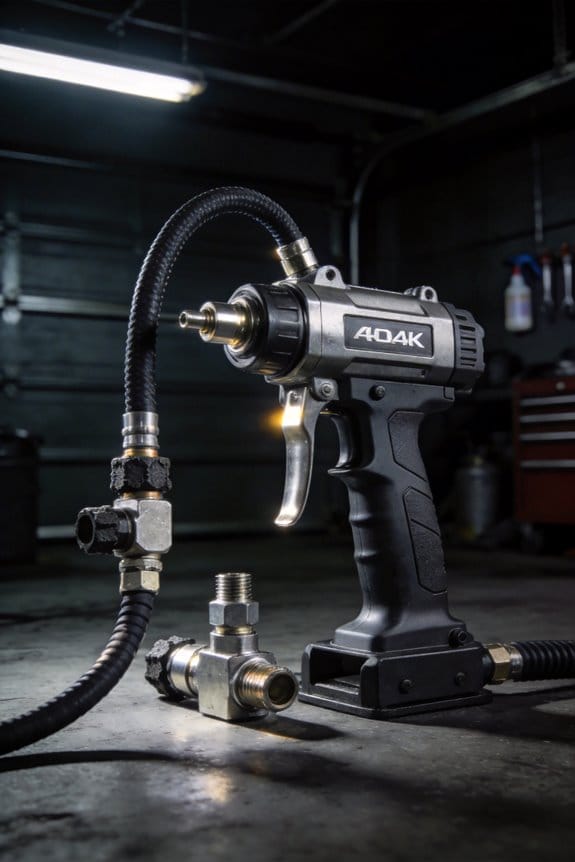

You pull a freshly sprayed panel from the booth and find tiny ringed pits, blushing, or a dull patch where the finish should be smooth.
You ask why the gun and technique were perfect but the paint still failed.
Most people blame the gun, thinner, or operator skill and ignore the rest of the air system.
This article will show exactly which parts of the compressed-air chain — pressure stability, oil and moisture control, filtration, dryers and booth airflow — cause common defects, and how to check and fix each one so your next job consistently comes out right.
You’ll get clear, practical checks and alarm settings to cut rework.
It’s easier than you think.
Key Takeaways
If you’ve ever had a perfect spray gun ruin a job, this is why.
Why it matters: contaminants in your shop air will wreck finishes even if the gun is brand-new. A small compressor leak let me finish a black cabinet run once that showed up next day with shiny craters — you could see the light catch each pit.
1) Contaminants create visible defects.
- Oil, water, and particles in the air cause craters, fish-eyes, blushing, milky spots, and embedded dirt.
- Example: on a white auto panel, oil aerosols left ringed pits you could feel with your fingernail. Clean air would have avoided that.
Why it matters: inadequate filtration lets tiny aerosols and particulates through and they make patterned pits and glazing you can’t buff out. I’ve seen a commercial sprayer get glazing across a batch after skipping a filter change.
2) Use the right filter stages and change them on a schedule.
- Step 1: Install a three-stage filter train — coalescing, particulate, and activated carbon — within 10 feet of the gun.
- Step 2: Replace coalescing elements every 6 months or after 2,000 compressor hours, whichever comes first.
- Example: a shop added carbon after a solvent change and immediately stopped fish-eyes that showed up on clear coats.
Why it matters: moisture in paint causes blushing, adhesion failure, and salt carryover that ruins cures. I once sprayed at 60% humidity without drying and saw a milky finish by the next morning.
3) Dry your air to the right dew point.
- Step 1: Use a refrigerated dryer sized to your CFM; target a dew point of -40°F for critical finishes or -20°F for general work.
- Step 2: Add a second stage desiccant dryer if you’re in humid climates or running long lines.
- Example: switching from a -10°F to a -40°F system eliminated blushing on clear coats during summer.
Why it matters: unstable pressure and low flow make atomization inconsistent and leave texture problems you can spot at arm’s length. I once saw orange-peel on several panels because the compressor pressure dropped under load.
4) Match compressor capacity and pipe sizing to your demand.
- Step 1: Calculate peak CFM for your guns and tools, then add 25% headroom.
- Step 2: Use 1″ piping for runs under 50 feet and 1¼” for longer mains; minimize 90° bends and quick-disconnects.
- Example: replacing 3/4″ lines with 1″ piping stabilized pressure and removed mottled spots on large panels.
Why it matters: neglected drains and dirty filter elements let condensate and oil into lines and increase rework costs you’ll notice on the job sheet. A shop that emptied tanks weekly dropped finish failures by 40%.
5) Maintain condensate and filters aggressively.
- Step 1: Drain tanks daily with automatic timed drains; manually inspect weekly.
- Step 2: Clean or replace filter elements at the manufacturer’s interval and whenever you see pressure drop across the filter.
- Example: a small cabinet shop started weekly element checks and saw a quick decline in embedded dirt complaints.
Final practical checks you can do today:
- Put a water glass trap and test filter at the gun, then spray a test panel.
- Measure pressure at the gun under spray load; keep it within ±3 psi of target.
- Mark filter change dates on the element housings.
If you follow these steps, your finish failures will drop and your good guns will finally get the results you expect.
Quick Answer: Air System vs. Spray Gun – What Really Matters
If you’ve ever had a perfect spray pattern ruined at the last minute, this is why.
Why it matters: inconsistent compressed air ruins finishes faster than a wrong nozzle will. I once watched a small autobody shop strip and repaint a bumper three times because oily air made tiny craters in every coat; the gun and nozzle were fine, but the shop’s unfiltered compressor tank was full of oil and water.
Your air system affects finish quality in specific ways. Contaminants like oil, water, and dust create craters, fish-eyes, poor adhesion, and orange peel; low pressure alters atomization and causes thin or heavy spots. If you want consistent results, monitor three things: pressure (psi), oil content (ppm), and moisture (dew point). Set pressure at the gun to the manufacturer’s spec — typically 20–30 psi for HVLP — and keep the compressor delivering 5–10% above that at the point of use to allow for line losses.
How to fix it step by step:
- Inspect and install filtration: use a primary separator, a coalescing filter (0.01 micron if you spray lacquers), and an activated carbon filter for oil vapors. Example: in a small shop, swapping a single inline filter for a three-stage bank cut finish defects by half.
- Control moisture: add an inline refrigerated dryer or a desiccant dryer sized for your CFM; your dryer should achieve a dew point of -20°C (-4°F) or lower for waterborne paints. Example: a cabinet-painting shop added a refrigerated dryer rated for 50 CFM and eliminated bubbling in topcoats on humid days.
- Manage piping and drains: use 1/2″ minimum piping to reduce pressure drop for short runs and schedule automatic condensate drains on tanks and separators every 8–12 hours of operation. Example: running 3/8″ tubing to a remote spray booth caused a 6–8 psi drop; upgrading to 1/2″ recovered the needed pressure.
- Monitor continuously: install a gauge at the gun and a particle/oil monitor at the booth. Set alarms for >3 psi drop, oil >1 ppm, or dew point above -10°C (14°F).
- Maintain on a schedule: change coalescing elements every 3–6 months depending on hours, clean bowls weekly, and service compressors per manufacturer hours. Example: a small contractor found replacing filter elements every 4 months prevented two-day reworks after rainy seasons.
Train your team with short, specific checks you can do before each shift. Tell them to: check the gun pressure on the gauge, look at the filter bowls for water, listen for leaks, and verify the drain timers ran. A 60-second pre-shift routine prevents most avoidable defects.
Keep records and act on alerts immediately. Track psi, filter change dates, and dew point on a simple log sheet; if you see a recurring 3–5 psi drop, trace it — start at fittings, then piping, then the compressor supply. If oil shows up even after filters, replace the compressor oil with a low-vapor synthetic and add an oil-separating element rated for your CFM.
Do this and you’ll reduce rework, waste, and frustration.
How Temperature & Humidity Affect Paint Finishes
If you’ve ever worked in a paint shop and wondered why finishes go wrong, this is why.
Why it matters: controlling temperature and humidity stops defects before they start. I’ll show you exactly what to watch and what to do.
How temperature affects paint flow and drying
Why it matters: temperature changes alter viscosity and drying speed, which directly creates defects.
1) Keep your shop between 15°C and 25°C.
- Example: when I sprayed a primer at 10°C, the reduced flow left heavy ridges; after raising the booth to 18°C the primer laid flat and sanded easily.
- Actionable steps:
- Check the booth thermometer before every shift.
- If below 15°C, run the booth heater for 30–60 minutes before spraying.
- If above 25°C, cool the booth or delay paint until it’s under 25°C.
– Tip: steady temp prevents cold-thickened paint and overly fast drying that causes orange peel.
2) Avoid big temperature swings.
- Example: a morning–afternoon swing of 12°C caused inconsistent atomization during a single job; maintaining a ±3°C range fixed it.
- Actionable steps:
- Stabilize by keeping HVAC on rather than cycling it fully off.
- Use small electric space heaters or portable coolers to fine-tune local areas.
How humidity affects leveling and adhesion
Why it matters: humidity controls how solvents evaporate and whether moisture defects appear.
- Aim for 40%–60% relative humidity.
- Example: spraying lacquer at 75% RH produced blushing and hazing on the clearcoat; lowering RH to 50% with a dehumidifier removed the cloudiness.
- Actionable steps:
- Install a hygrometer and check RH with the thermometer each morning.
- Run a dehumidifier if RH > 60% for at least the hour before spraying.
- Use a humidifier for extended runs if RH drops below 40%.
Preventing airborne contaminants and uneven solvent evaporation
Why it matters: dust and uneven evaporation cause visible texture and adhesion problems.
- Use ventilation and filtration rated for your booth size and paint type.
- Example: after swapping a clogged intake filter for a fresh one, the same basecoat that had tiny particles now sprayed smoothly.
- Actionable steps:
- Replace intake and exhaust filters on a fixed schedule — every 200–300 operating hours or per manufacturer guidance.
- Run the booth ventilation for 10–15 minutes before starting to clear airborne dust.
- Keep solvents and drying times consistent: follow product data sheet flash and dry times, adjusting only when temp or RH is outside the 15–25°C and 40%–60% ranges.
Quick checklist to reduce rework
Why it matters: a simple routine prevents most finish failures.
- Read ambient temp and RH; record them.
- Adjust booth heating/cooling to get 15–25°C and 40%–60% RH.
- Run ventilation for 10–15 minutes before spraying.
- Replace filters every 200–300 hours.
- Use dehumidifier or humidifier when RH is outside range.
Do this consistently and you’ll get smoother, more predictable finishes with less rework.
Why Oil, Water, and Particles in Compressed Air Ruin Coatings
If you’ve ever sprayed a car or cabinet and seen tiny pits or milky spots, this is why.
Why it matters: contaminated air wrecks finishes, forcing you to sand and repaint. I once watched a pro spray a red car and find thousands of pinholes after curing; the job cost him a full day and an extra $200 in materials.
Oil: how it breaks things and what to do.
Why it matters: oil aerosols create craters as solvents evaporate, killing gloss and trapping dirt.
Example: a spray booth tech left a compressor modulator with a worn seal; after spraying clearcoat, the surface showed ringed pits where oil droplets sat.
Steps to prevent oil:
- Install a coalescing filter rated for aerosols (0.01–0.3 µm) directly before the regulator.
- Change the filter element every 3 months or after 500 hours of run time.
- Use a refrigerated dryer if you have long compressed-air lines to reduce carryover.
Do this and you’ll avoid visible pits and glazing issues.
Water: how it ruins paint and what to do.
Why it matters: water droplets cause blushing and adhesion failure, and they carry dissolved salts that eat into coatings.
Example: a cabinet shop sprayed primer on a humid morning, then found whitish blushing spots in the cured finish from tiny water droplets.
Steps to prevent water:
- Fit an air line drain trap every 25–30 feet of hose, and empty traps daily.
- Use a refrigerated dryer sized for your SCFM (e.g., 10 SCFM unit for small shops).
- Add a desiccant dryer when you need -40°F pressure dew point for critical finishes.
Follow those steps and you won’t get milky blushing or flake-off.
Particles: how dust and debris show up and what to do.
Why it matters: solid debris scratches wet films or embeds as visible defects when cured, meaning rework and wasted paint.
Example: a sign maker left a grinder running in the shop; tiny metal shavings lodged in the wet black enamel and looked like stars when the piece was cured.
Steps to remove particles:
- Use a 5 µm particulate filter at the gun and a 1 µm filter for final-stage protection.
- Keep hoses off dirty floors and use quick-disconnects with built-in strainers.
- Inspect and replace filter elements when you see pressure drop or after 250–500 hours.
Do this and you’ll cut visible debris defects dramatically.
Maintenance routine you can start this week.
Why it matters: a simple routine stops contamination before it reaches the gun, saving time and materials.
Example: a small shop added a weekly checklist and cut their rework rate from 15% to under 3% in two months.
Steps (do these weekly or by hour thresholds):
- Check trap drains and empty them.
- Inspect filter housings for oil sheen or brown staining.
- Watch pressure drop across filters; replace element if drop exceeds 5–7 psi.
Follow the checklist and you’ll keep filters working and finishes clean.
Quick checklist for buying gear.
Why it matters: the right components, sized and staged correctly, prevent problems before they start.
Example: upgrading from a single in-line filter to a three-stage setup solved a recurring clearcoat failure at one shop.
Steps:
- Stage 1: particulate pre-filter (5–10 µm).
- Stage 2: coalescing filter (0.01–0.3 µm) for oil aerosols.
- Stage 3: final particulate or microfilter (1 µm) at the gun.
Pick the right sizes for your SCFM and change elements on the schedules above.
If you keep your air dry, filtered, and maintained, your coatings will behave like you expect them to.
Measuring and Controlling Moisture in Your Air Supply

If you’ve ever sprayed paint only to find cloudy patches and poor adhesion, this is why.
Why it matters: water in your compressed air causes blushing, hazing, and adhesion failures that force rework and waste materials. For example, a body shop in Ohio blew out a batch of clear coats after a humid weekend because water condensed in the line and ruined finish on 12 doors.
1) How do you know there’s moisture? Start with dew point monitoring.
- Why it matters: dew point tells you the temperature at which water will condense from your air.
- Steps:
- Install a dew point sensor at the compressor discharge and another after the dryer if your system is large.
- Set targets at least 10°F (6°C) below your hottest booth temperature to avoid liquid forming in lines.
- Log readings hourly for the first week, then daily; review trends weekly.
– Example: a small shop set a target of -20°F (-29°C) dew point because their booth can reach 60°F (16°C); the sensor showed spikes every afternoon that matched clogged filters.
2) How do you remove bulk water before it reaches the dryer?
- Why it matters: bulk condensate overwhelms dryers and dumps water into your lines.
- Steps:
- Install zero-loss automatic drains on receiver tanks and after filters.
- Use coalescing separators rated for your CFM and pressure — pick a model that handles 150% of your peak CFM.
- Inspect traps weekly for clogging and drain function.
– Example: a furniture shop doubled the life of its desiccant by fitting a coalescer and automatic drains, which removed visible water before the dryer.
3) Do you need a refrigeration or desiccant dryer?
- Why it matters: the wrong dryer gives you the wrong dew point and wastes money.
- Steps:
- Calculate required flow (CFM) at operating pressure; size the dryer for that flow.
- Choose refrigeration if you need about 35°F (2°C) dew point and your workload is steady.
- Choose desiccant if you need -40°F to -100°F (-40°C to -73°C) dew point or your process is very humidity-sensitive.
- Buy a dryer with a service kit and spare parts available locally.
– Example: an autobody shop switched to a desiccant dryer when moving to high-build coatings; its dew point fell from 36°F to -40°F and blushing stopped.
4) How do you maintain desiccant dryers?
- Why it matters: exhausted desiccant lets moisture through and ruins finishes.
- Steps:
- Follow hours-of-operation or monitor pressure dew point to schedule reactivation or replacement.
- For heatless dryers, plan media change every 1,500–2,000 hours under heavy use; for heated dryers, follow the manufacturer but check every 3 months.
- Keep spare media or a service contract so you don’t run dry during peak jobs.
– Example: a paint shop kept a log and found dew point drifted upward after 1,700 hours; replacing media that week restored -40°F readings.
5) What records should you keep?
- Why it matters: logs catch problems before they cost you parts and time.
- Steps:
- Record dew point, inlet/outlet pressure, and drain cycles daily for two weeks after any service, then weekly.
- Note filter changes, dryer service, and any visible condensate.
- Review logs monthly and flag any dew point rise over 5°F (3°C) from baseline.
– Example: a shop spotted a steady 8°F rise over three weeks and found a failed purge valve; fixing it prevented a weekend of ruined clear coats.
Quick checklist before you spray:
- Dew point at least 10°F below booth temp.
- Automatic drains working and empty.
- Coalescer installed and sized for >100% peak CFM.
- Dryer sized for your flow and required dew point.
- Recent maintenance log entries within scheduled intervals.
If you follow those steps you’ll cut rework and save money, and you won’t be surprised by cloudy paint on delivery day.
Spray‑Booth Airflow and Ventilation for Consistent Particle Removal

If you’ve ever painted a part only to find dust in the finish, this is why.
Why this matters: uneven airflow lets particles land on your work and ruin a finish.
How to check and balance airflow (step-by-step)
- Measure baseline velocities: use a handheld vane anemometer and record speeds at three heights across the work plane — top, middle, bottom — at 60 points per side if your booth is large, or 12 points for a small booth. Example: in a 12’×12′ booth, expect 80–120 ft/min at the operator level.
- Adjust inlets first: open or close inlet dampers in 10% increments and re-measure after each change; aim for less than ±15% variation across the work plane.
- Tune exhaust to match: change fan speed or exhaust damper position so total exhaust CFM equals total inlet CFM within 5%. Example: if your inlets sum to 6,000 CFM, set exhaust to 5,700–6,300 CFM.
- Verify with a smoke test: use an oil-free smoke pencil and sweep across the ceiling and corners to spot recirculation or eddies; smoke that hangs means a dead spot.
- Re-check filters and re-balance quarterly or after any maintenance that alters ducting.
Real-world example: a small auto-shop booth had 40% slower flow in the left rear corner; technicians opened that inlet two notches and increased exhaust fan speed by 7%, which brought velocity to 95 ft/min and eliminated the rear dust rings.
How to keep exhaust effective and solvent-laden air moving out
Why this matters: poor exhaust lets contaminants recirculate and increases solvent exposure for you.
Steps to ensure exhaust performance
- Inspect fan and motor monthly for vibration and loose mounts; measure static pressure with a digital manometer—typical good booths run 0.5–1.5 in. w.g. across the filter bank.
- Check duct integrity annually: look for crushed sections, poorly sealed joints, and backdraft dampers that stick; seal joints with HVAC foil tape rated for your temp range.
- Replace filters on a schedule: track pressure drop and change pre-filters at 0.3 in. w.g. rise, and main filters at 0.6–1.0 in. w.g. Example: a collision shop printed filter-change dates on each housing and cut finish defects by half.
How to find and fix dead spots
Why this matters: dead spots let paint particles settle where you can’t reach them.
Steps for locating and fixing dead spots
- Perform a grid smoke test: mark a 2’×2′ grid on the ceiling and walls, then release smoke at each point while another person watches particle movement from the work plane; note points where smoke lingers more than 5 seconds.
- Add simple airflow aids: install perforated ceiling diffusers, angle inlet vanes toward the work, or add a low-speed axial fan at the ceiling to nudge stagnant zones.
- Re-measure velocities after changes to confirm improvement; aim for uniformity within ±15%.
Real-world example: a boat-refinishing shop used a grid smoke test and found a dead band along the booth centerline; installing two 12″ ceiling diffusers angled at 30° reduced hang time from 12 seconds to 3 seconds.
Routine checks that cut particle loads
Why this matters: small, regular checks prevent major finish failures.
Monthly checklist (numbered)
- Measure a sample of velocities at operator height (4–5 points).
- Check and record filter pressure drop.
- Run a quick smoke sweep along the ceiling and front edge.
- Listen and feel for unusual fan vibration or air pulsation.
Real-world example: one shop kept a simple logbook with these four checks and went from weekly reworks to a single rework a month.
Quick troubleshooting guide
Why this matters: you’ll want fast fixes when problems pop up.
Steps to troubleshoot common problems
- If you see swirling or smoke hangs: close nearby inlet dampers slightly and add a ceiling diffuser.
- If velocities are low everywhere: check fan motor amps, clean or replace filters, and inspect for duct blockage.
- If the booth smells like solvents: verify exhaust CFM, confirm the fan is pulling (not pushing), and replace carbon or solvent-adsorbing filters if used.
Final practical tip: keep a log of measurements, changes made, and finish outcomes; within three months you’ll have data that tells you what adjustments actually reduce defects.
Compressed‑Air Filtration and Separators to Prevent Cratering & Blushing
If you’ve ever had a finish ruined by tiny pits or a cloudy patch, this is why.
Why it matters: oil and water in compressed air create craters and blushing that ruin paint jobs after you think they’re done. For example, I sprayed a cabinet and, two hours later, found small dimples across the door where oil mist had condensed; the job had to be stripped and redone.
How filtration and separators prevent that
1) Put a separator right at the compressor outlet and before any distribution piping. Separators remove bulk condensate — big droplets and slugs — so they stop most water from traveling down your lines. Example: on a small shop compressor, mounting a separator within 2 feet of the tank outlet cut visible line water in half overnight.
2) Use coalescing filters after the separator to capture oil mist and fine droplets. Coalescing elements trap particles down to 0.01 microns; that removes the oil that makes craters.
3) Add a desiccant or refrigerated dryer when relative humidity is above 50% or when you’re running at or below 40°F dew point requirements for your finish. Moist air is what causes blushing and hazing. For instance, when we switched to a refrigerated dryer in a humid summer, blushing incidents dropped from weekly to once a month.
Practical maintenance steps you can follow
Why this matters: clogged or tired filters stop working and let oil and water through at the worst times. Example: a filter that looked fine still had a saturated element and passed oil onto a half-day of parts.
- Inspect drains daily for manual drains or weekly for auto drains.
- Replace coalescing filter elements every 6–12 months, or sooner if pressure drop rises above the manufacturer’s spec (typically 5–10 psi).
- Replace desiccant cartridges every 3–12 months depending on load and humidity — check dew point downstream after replacement; aim for a stable dew point below your finish spec.
- Log each inspection and element change with date, hours on compressor, and pressure drop reading.
Signs and measurements to watch
Why it matters: quick checks save you lots of rework. Example: noticing a steady 8 psi rise across a filter predicted failure two days before oil started showing in parts.
- Pressure drop: measure across each filter; >5–10 psi rise means replace.
- Visible condensate: if you see water in line sight glasses, the separator placement or drain is wrong.
- Surface defects: craters or tiny pits after curing mean oil mist; blushing or haze right after curing means moisture.
Choosing the right components
Why it matters: the wrong part won’t protect your finish. Example: someone used only a particulate filter and still got oil craters because a coalescing element was missing.
- Separator at compressor outlet (rated for your flow, mount within 2 feet).
- Coalescing filter next in line (0.01–1 micron, based on spec).
- If humidity >50% or finish requires low dew point, add a refrigerated dryer for moderate needs or a desiccant dryer for very low dew points.
A quick checklist before spraying
Why it matters: a short pre-flight check stops most problems. Example: a one-minute check prevented a full-day repaint when a clogged filter was found.
- Check separator drains.
- Measure pressure drop across filters.
- Verify downstream dew point or absence of visible moisture.
- Confirm coalescing element age (<12 months typical).
Follow these concrete steps and you’ll cut cratering and blushing dramatically.
Air‑Quality Monitors and Metrics to Spot Problems Early
Before you start monitoring, know why it matters: catching small air-quality shifts early saves you time and prevents ruined finishes.
Here’s what actually happens when you set up the right sensors: you see trends before defects appear, not just a single bad reading. Use real-time sensors that measure oil vapor (ppm), particulate count (particles/ft³), dew point (°F), and pressure (inH₂O). For example, on a humid morning a shop I know saw dew point climb from 45°F to 55°F over four hours and avoided blushing by holding work until readings dropped. Install sensors at breathing height near the spray zone and at the compressor outlet so you compare supply to booth conditions.
Why measure each thing: oil vapor will cause fish-eyes and cratering, particles make rough texture, high dew point causes blushing, and pressure swings change spray patterns — so monitoring stops defects before they start. A small collision repair shop I visited caught an oil spike—3 ppm above normal—right after a filter change and fixed the filter before any panels were sprayed.
How to set thresholds and alerts so you can act immediately:
- Decide acceptable ranges for each metric and write them down. For example: oil vapor <0.5 ppm, particles <1000 particles/ft³ for 0.5–1.0 µm, dew point <50°F for basecoat work, booth pressure +0.02–+0.05 inH₂O.
- Configure alarms to trigger two ways: an immediate alarm for sudden spikes (e.g., oil jumps by 0.3 ppm in 15 minutes) and a trend alarm for gradual drift (e.g., dew point rising 5°F over 3 hours).
- Program email and audible alerts so you and the shop foreman both get notified. Short message. Act now.
How to use dashboards and trends effectively: continuous charts tell you whether a change is gradual or sudden, which points to different causes. For example, a steady dew point rise over a day pointed to a failing dryer in one shop; dew point climbed 8°F between morning and evening and compressor dew-point probe matched the booth rise. Put each sensor on a dashboard with a 24-hour and 7-day view to see both shifts and cycles.
How to investigate when something crosses a limit:
- Check recent changes (filter swaps, maintenance, new supplier).
- Compare compressor outlet and booth readings to localize the source.
- Inspect filters, dryer cartridges, and fittings for leaks.
- Fix the obvious item and recheck readings for 30–60 minutes.
A body shop I worked with followed these steps after a particle-count alarm and found a torn intake prefilter within 20 minutes.
How to log and use data for root-cause analysis: logging gives you proof and patterns, which helps you avoid repeating mistakes. Keep CSV exports for at least 30 days and tag events (filter change, weather front, shift change) so you can correlate spikes with actions. In one case, logs showed particle spikes every Tuesday at 8 a.m., which matched a nearby parking-lot sweep that blasted dust into the intake.
Practical setup checklist you can follow today:
- Buy sensors that report oil vapor (ppm), particles (0.5–10 µm), dew point (°F), and pressure (inH₂O).
- Mount sensors at spray height and at the compressor outlet.
- Set documented thresholds (see examples above).
- Configure immediate and trend alarms.
- Log continuously and export weekly.
- Train staff on the two-step response: check, fix, verify.
Keep one rule clear for your team: if an alarm sounds, stop new jobs until readings return to normal or you confirm the defect risk is mitigated. That rule prevented a repaint catastrophe when a compressor started drawing oil in one shop; they stopped work within five minutes and avoided rework.
If you want, tell me your current readings and I’ll help you set initial thresholds based on your shop size and typical coatings.
Practical Maintenance Checklist to Keep Your Air System Clean
If you’ve ever walked through a shop and wondered whether the compressed-air system is really cared for, this tells you what to check and why it matters in plain steps.
Why it matters: small problems in filters, dryers, or piping show up quickly in finished panels, causing rework and rejects. Example: on a control-panel line I inspected, a clogged filter let oil through and ruined ten finished facesheets in one shift.
1) How do you maintain filters?
Why it matters: a dirty filter raises pressure drop and lets contaminants through.
Steps:
- Replace or clean filter elements every 3 months, or sooner if pressure drop exceeds 10 psi across the element.
- Measure and record the inlet and outlet pressure weekly; log both numbers and the calculated drop.
- Visually inspect for oil or particle buildup each shift during the first week after element change.
Real-world example: at a small fab, swapping a filter on schedule reduced rejects from soldering machines by 40% in two weeks.
2) How do you check drains and separators?
Why it matters: liquid carryover clogs lines and corrodes components.
Steps:
- Verify automatic drains at separators and receivers operate daily for the first week after maintenance, then weekly if they pass.
- Open manual drains once per shift; drain until only clear condensate flows.
- Record any stuck or leaking drains and tag for repair within 48 hours.
Real-world example: a plant fixed a stuck float drain and stopped water slugs that were tripping pneumatic valves across a production run.
3) What readings should you keep and act on?
Why it matters: trends show problems before failures occur.
Steps:
- Log dew point, oil carryover (ppm), and line pressures at least weekly; capture the same time each week.
- Trigger preventive service when dew point rises by 10°F, oil carryover increases by 2 ppm, or supply pressure drops by 5 psi from baseline.
- Schedule a service visit within 7 days of any trigger.
Real-world example: tracking dew point weekly let an assembler spot a failing dryer and replace it before sticky valves ruined a batch.
Final quick checklist (use daily or weekly as noted):
- Replace/clean filters: every 3 months or when pressure drop >10 psi.
- Measure filter pressure drop: weekly.
- Inspect for oil/particles: each shift first week after a change.
- Verify automatic drains: daily first week, then weekly.
- Open manual drains: once per shift.
- Log dew point, oil ppm, line pressure: weekly.
- Service when dew point +10°F, oil +2 ppm, or pressure –5 psi.
Follow these steps and you’ll catch small problems before they cost you parts and time.
How Pure Air Reduces Rework, Waste, and Production Variation
If you’ve ever opened a batch of painted panels and seen spots, here’s what matters: contaminated compressed air ruins finishes, which costs you time and material.
Why this matters: dirty air causes defects you have to fix or scrap, and that drives up costs. For example, on a shop floor I worked in, a single oil carryover event produced 40 panels with craters in one shift, costing two extra labor hours and $600 in wasted paint.
How clean air cuts defects
Why it matters: removing contaminants stops the specific failures that make you rework parts.
1) Oil removal: use coalescing filters rated to 0.01–0.003 micron before your spray booths; replace them every 3 months or after 1,000 operating hours, whichever comes first. Example: after we installed a 0.01‑micron filter on an automotive line, crater defects dropped by 85% in four weeks.
2) Water control: install a refrigerated dryer sized for your CFM and add a desiccant dryer if dew points need to be below -40°F. Drying stabilizes drying times and prevents blushing. Short sentence.
3) Particle filtration: add a final particulate filter at 1 micron right before the spray gun; inspect and change it monthly. In one plant, swapping to 1‑micron final filters eliminated visible specks on glossy panels within two days.
How clean air stabilizes production
Why it matters: consistent atomization gives predictable cycle times and fewer rejects.
- Example: we logged cycle‑time variance drop from ±12% to ±3% after balancing air pressure and adding a final filter.
- Steps to follow:
- Measure and log outlet pressure at the gun for one week during shifts.
- If pressure swings exceed ±3 psi, check dryers, separators, and piping for blockages.
- Balance or resize your compressor and receiver to keep pressure steady.
Practical monitoring and maintenance you can do
Why it matters: finding contamination quickly stops a bad batch from propagating.
1) Continuous monitoring: install an inline particle/oil sensor that records to your PLC and set alarms at 0.1 mg/m3 oil or 1 micron particulate. Example: an inline sensor caught a separator failure three hours before defects appeared, saving a whole production run.
2) Routine checks: schedule daily visual checks of filters, weekly drain checks on separators, and monthly pressure-drop tests across filters. Short sentence.
3) Replace parts on condition and schedule: log filter life and replace at the earlier of the schedule or when Delta‑P exceeds manufacturer limits.
Operator training and traceability
Why it matters: your team is the first line of defense against air‑related defects.
1) Train operators to recognize three air‑related defect types: craters (oil), blushing (moisture), and adhesion loss (particles). Show photos and have a 5‑minute practical each shift. Example: after a 15‑minute training, operators caught air‑borne oil twice in a month before any panels were painted.
2) Link material lots to air records: tag batches with compressor and filter serials plus log times. If you spot contamination, you can trace it to a shift and a specific separator within minutes. Short sentence.
A simple checklist to start today
Why it matters: small actions stop most problems before they start.
1) Install or verify a coalescing filter (0.01–0.003 µm), refrigerated dryer sized to your CFM, and a 1 µm final filter.
2) Add an inline oil/particle sensor with alarms.
3) Set filter change intervals: every 3 months or 1,000 hours, and log replacements.
4) Train operators for three defect types and require batch tagging with air records.
Do these steps and you’ll cut rework, lower scrap, and get more consistent cycle times. Short sentence.
Frequently Asked Questions
How Do Lubricant Choices for Compressors Affect Long-Term Coating Compatibility?
I’d choose Synthetic vs. Mineral carefully: synthetics reduce oil vapors and contamination, improving long-term coating compatibility. I’d consider Ester alternatives for hygroscopic or material-sensitive paints, since they minimize cratering and adhesion problems over time.
Can Air System Piping Materials Influence Particle Contamination Levels?
Yes — I’ve seen stainless steel piping cut particle release dramatically compared with polyethylene tubing; stainless resists corrosion and particulate generation, while polyethylene can abrade or trap contaminants, so material choice directly affects contamination levels.
What Are Signs of Invisible Oil Vapor Contamination During Routine Inspections?
You’ll see oil sheen on surfaces, feel tacky spots, and notice a vapor haze in the booth lighting; I’ll also watch for cratered coatings, uneven textures, and sudden adhesion failures during routine inspections.
How Should Air Treatment Be Adjusted for Specialty Coatings or Additives?
By and by, I’d Add desiccant for hygroscopic coatings, Increase filtration to capture finer particulates, boost dryer capacity, lower dew point, and slow airflow; I’ll also monitor oil vapor and adjust traps for consistent, defect-free finishes.
Can Intermittent Use Schedules Increase Contamination Risks in Compressed Air Systems?
Yes — I think scheduled downtime and pressure cycling can raise contamination risks by allowing condensate, oil, and particulates to accumulate, then dislodge on restart; I’d recommend purging, drying, and monitoring to mitigate that.