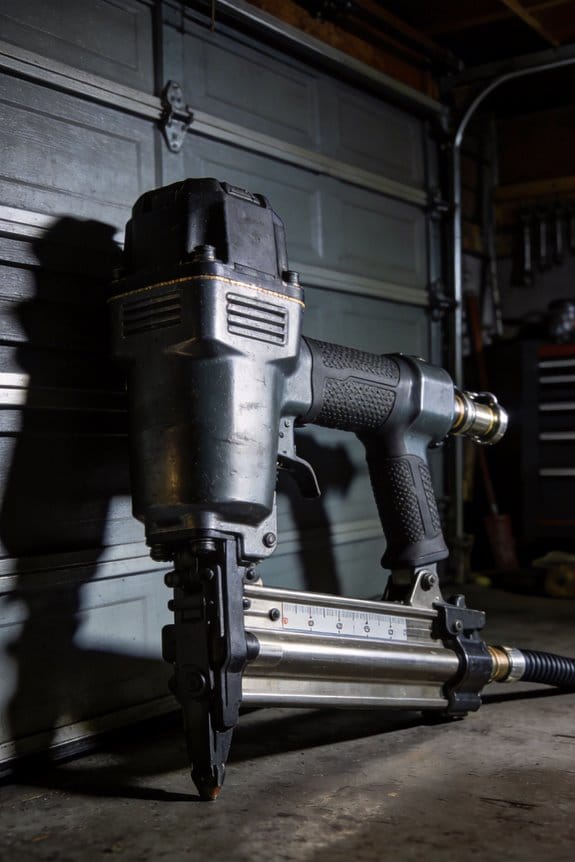

You just finished a long day on a roof and realized your framing nailer kept jamming, or you watched a siding job where nails sat proud and shingles split.
You’re asking which tool actually speeds the job and prevents fastener failures: a roofing or siding nailer — and which features matter most.
Most people assume any pneumatic nailer will do and buy the cheapest model, then wonder why reloads, rust, or depth issues slow them down.
This piece will show you the exact nailer features that save time and reduce callbacks, the fastener types to match each tool, and clear rental and maintenance steps so you can finish large exterior runs without rework.
You’ll get concrete buy-or-rent guidance and upkeep checks.
It’s easier than it looks.
Key Takeaways
If you’ve ever wrestled with a long day of roof or siding work, this is why.
You want consistent drive depth because over- or under-driven nails cause leaks or loose boards; a roofing/siding nailer gives you that, usually settable in 6–12 detents so you can dial in flush drives for 1/2″ shingles or 5/16″ siding. Example: on a 24-square roof with asphalt shingles, using the depth dial set to 8 keeps nails flush and avoids blow-off spots.
Coil magazines hold 200–300 nails versus 20–40 in a stick nailer, so you stop less often and keep your pace. Real-world: on a 50-foot siding run, a coil nailer cuts reloads from every 10 minutes to roughly every hour when you run 1¼” siding nails.
You should protect materials because nails that hit too deep or rip shingles cause leaks and visible damage; features like adjustable depth, skid guards, and rubberized tips prevent that. For instance, flip on the skid guard and use the rubber tip when nailing starter shingles to avoid tearing the shingle tabs.
Before you pick a firing mode, understand how it saves time: bump mode lets you fire rapidly while sliding along the surface, and sequential mode reduces misfires when you need precision. Example: on a windy day with loose shingles, switch to sequential and keep every nail accurate.
You want tools that reduce downtime and repairs; ergonomics, easy maintenance, and matching the gun to the nail type cut service costs and slowdowns. Try these steps:
- Match fastener length and gauge to the nailer (e.g., 1″–1¼” aluminum-clad roofing nails for an aluminum roof gun).
- Clean and oil the gun every 4–6 hours of use.
- Replace worn O-rings and filters at the first sign of air leaks.
Following that schedule will keep a crew productive across multi-day jobs.
Why Roofing and Siding Nailers Are a Distinct Tool Category
If you’ve ever climbed up on a roof or stood next to a wall of lap siding, this is why the nailer matters.
Why it matters: using the right nailer keeps your shingles and siding from failing later. Roofing and siding nailers are built for repetitive, outdoor fastening so they give you consistent depth control, corrosion resistance, and faster cycles than a general framing gun.
How they differ from general nail guns
Why it matters: matching features to the task saves time and prevents damage.
1) Coil magazines: these hold 100–300 nails so you spend less time reloading; for example, a roofer doing a 20-square roof can go longer between reloads than with stick nails.
2) Adjustable depth settings: set the depth so every shingle head is flush without crushing the shingle; aim for the nail head to sit just below the shingle surface, about 1–2 mm.
3) Corrosion-resistant materials: many roofing nails and nailer parts are galvanized or stainless to resist rain; for instance, a coastal job needs stainless or you’ll get rust stains within months.
4) Skid guards and tip designs: these protect shingles and siding from scuffs when you press the tool down; they reduce cosmetic damage on cedar shakes during a long day.
A specific example: a crew installing vinyl lap siding used a siding-specific nailer with a 120-nail coil and rapid-fire settings and finished a 2,000 sq ft house in two days; with a framing gun they’d have reloaded constantly and risked overdriving nails.
When you should buy one
Why it matters: the right purchase lowers downtime and repair costs.
1) Buy a roofing or siding nailer if you fasten shingles or lap siding more than twice a month.
2) Rent or borrow if you have one-off jobs under a day.
3) Choose corrosion-resistant models for exterior jobs within 5 miles of salt water.
A specific example: if you roof three small garages in a season, owning a coil roofing nailer pays off; renting for a single 10-sheet shed doesn’t.
Quick checklist for choosing a model
Why it matters: this prevents buying the wrong tool.
1) Nail type compatibility — confirm it takes the nails your materials require (heavier gauges for cedar, stainless for coast).
2) Magazine capacity — 100+ for roofing/siding is ideal.
3) Depth adjustability — must allow fine control (1–2 mm increments).
4) Materials and finish — look for galvanized or stainless parts.
5) Weight and skid guard — lighter with a protective tip reduces fatigue and surface damage.
A specific example: pick a 6–7 lb siding nailer with a rubber skid guard if you plan to work 8+ hours a day; this combination reduces wrist strain and keeps finish materials clean.
Bottom line: you should treat roofing and siding nailers as their own category because they’re optimized for high-volume, outdoor fastening; pick one that matches nail type, capacity, depth control, and corrosion resistance so your work goes faster and lasts longer.
Nailer Types: Coil, Stick, Roofing, Siding – How They Differ

Here’s what actually happens when you pick a nailer for a job: the tool’s magazine, nail size range, and firing style change how fast and accurately you finish. You care because choosing the wrong nailer wastes time, costs extra nails, and can damage the workpiece.
Coil nailers hold a large number of nails in a coiled strip so you reload less on long runs. Example: when you’re installing 800 linear feet of roof sheathing and need fewer stops, a coil nailer with 2,000–3,000 nails on a coil saves you multiple reloads. How to use one:
- Load the coiled strip into the drum.
- Set the depth to flush with the wood (usually 3–5 mm below surface for framing).
- Test-fire into scrap to verify depth and feed.
Coil nailers accept wire-welded nails and sometimes plastic-collated roofing nails, and they can be heavier, so balance matters when you work overhead.
If you’ve ever struggled carrying a heavy tool all day, stick nailers are the lighter option built for mobility and balance. Example: when framing walls all afternoon, a stick nailer with 21–30° angled magazines feeds 30–100 nails and weighs noticeably less, which reduces arm fatigue. How to use one:
- Slide a straight strip into the magazine until it clicks.
- Adjust the depth dial to sink the head flush (about 1–2 mm below finish for trim).
- Fire in controlled bursts to avoid jams.
Stick nailers are common for framing and trim because they take standard straight strips and are quicker to aim in tight spots.
The difference between roofing nailers and other nailers comes down to depth control and nail head design. You care because shingles need a consistent clinch to resist wind. Example: when nailing 30-year asphalt shingles, use a roofing nailer set to drive the head flush without tearing the shingle, with 1/2″ to 3/4″ shank lengths typical. How to use one:
- Use collated roofing nails with a 3/8″ to 1/2″ head.
- Set the depth so the head sits flush but doesn’t cut the shingle.
- Keep shots 5–6 inches apart across the shingle course.
Roofing nailers often use plastic- or paper-collated coils made for high-speed, repetitive nailing.
Before you start siding, you need to know siding nailers are built to avoid splitting and allow panel movement. You care because siding expands and contracts with temperature. Example: when installing cedar lap siding, a siding nailer with an angled nose and adjustable fence lets you place nails at the top of the butt so the board can move; use 1-1/4″ to 1-1/2″ stainless or hot-dipped galvanized nails. How to use one:
- Set the fence to the manufacturer’s recommended distance from the edge (commonly 3/8″–1/2″).
- Adjust depth so the head is just below the paint surface (about 0.5 mm).
- Nail through the top edge or in the nailing hem per siding type.
Siding nailers often have narrower noses and depth settings optimized for thin, brittle materials, which minimizes splitting.
Quick recap with the one critical tip for each type:
- Coil: choose for long runs; expect heavier weight.
- Stick: choose for general framing and tight spots; expect better balance.
- Roofing: choose for consistent depth on shingles; use 3/8″–1/2″ heads.
- Siding: choose for controlled placement and minimal splitting; set fence precisely.
Quick Guide: Which Roofing or Siding Nailer Should You Choose?

Before you pick a roofing or siding nailer, know this: matching magazine type, nail size range, and firing mode to your job decides speed, balance, and finish.
1) Which magazine should you choose?
Why it matters: the magazine determines how often you’ll reload and how the tool sits in your hand.
Example: on a 2-day reroof of a 1,500 sq ft house with 30 lb. shingles, you’ll want fewer interruptions.
Steps:
- Use a coil magazine for high-volume roofing — coils hold 1,000+ nails (typical 2,000–3,000 nails per coil on 1¼” roofing nails) so you reload less.
- Use a stick magazine for trim and siding — sticks hold 100–150 nails and keep the tool slimmer for working on ladders.
- If you swap tasks, keep both magazines or rent the other tool for the day.
2) What nail sizes and ranges should you match?
Why it matters: wrong nail length or gauge ruins the finish and weakens the job.
Example: when installing 5/8″ cedar lap siding over 3/8″ furring strips, the nail must penetrate framing by at least 1″.
Steps:
- Check nail length: choose a nail that gives at least 1″ embedment into framing (e.g., 1½” nails for 5/8″ siding over 3/8″ furring).
- Check gauge: roofing usually uses thinner shank nails (e.g., 11–12 ga), while siding and trim often use 11 ga or 10 ga depending on holding needs.
- Match nail head type to material: capped nails for shingles, ring- or spiral-shank for siding where pullout resistance matters.
3) Which firing mode should you pick?
Why it matters: firing mode controls your speed and how many mistakes you make.
Example: when fitting tight siding joints on a historic house, you need precise placement.
Steps:
- Choose single-shot (sequential) for precise work — every nail is deliberate.
- Choose bump-fire (contact) for fast roofing where you’re running and stapling repeatedly.
- If you switch between precision and speed during a job, use a nailer that switches modes and keep the manual handy.
4) Cordless vs. pneumatic and battery considerations
Why it matters: power source affects mobility and how long you can work without downtime.
Example: installing siding on a remote cabin means no compressor access.
Steps:
- If cordless, match battery voltage and spare count to runtime — aim for two full spare batteries per battery-powered nailer for an 8-hour day (e.g., two 5.0 Ah spares for a 6–8 Ah-equivalent workload).
- If pneumatic, size your compressor for steady shots — a 6–8 gallon, 2.5–3.0 HP compressor usually handles siding work; roofing at pace may need a larger tank or extras.
- Store batteries and gas cells per manufacturer temps: keep batteries at 40–80°F and gas cells sealed dry during off-season.
5) Seasonal storage and reliability
Why it matters: poor storage makes nailers fail when you need them most.
Example: a saved gas cell left in a garage over winter can leak and gum up the engine.
Steps:
- Drain air lines and oil pneumatic tools, then store indoors above freezing.
- Remove batteries and store at about 50% charge in a cool, dry place.
- Dispose of or rotate gas cells rather than leaving them installed for months.
Quick checklist before you start a job:
- Match magazine: coil for roofs, stick for trim/siding.
- Match nail length: at least 1″ into framing.
- Pick firing mode: single-shot for precision, bump-fire for speed.
- Bring two spare batteries or a compressor sized to the tool.
- Store consumables and power sources correctly between seasons.
If you follow those steps, your nailer choice will fit the job and save you time and rework.
Productivity Gains From Roofing & Siding Nailers: Speed, Capacity, Cycle Time
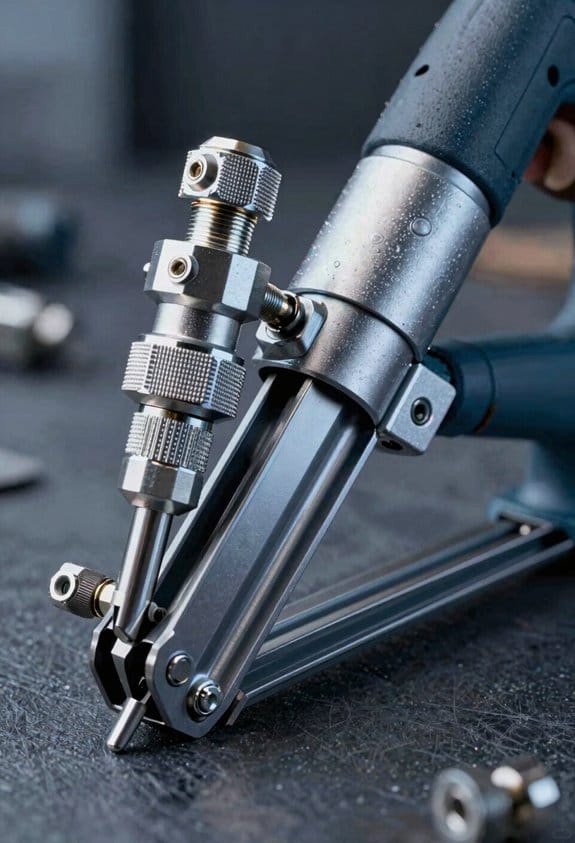
Here’s what actually happens when you use a nailer on a roofing or siding run: it changes how much work you get done every hour by altering three concrete numbers — firing speed, magazine capacity, and cycle time — and that affects your labor and downtime.
Why this matters: faster throughput and fewer reloads mean you finish sooner and spend less on labor.
Firing speed — how many nails per second
- Concrete point: some roofing nailers fire up to about 3 nails per second (roughly 180 nails per minute); many siding nailers do 1–2 nails per second (60–120 nails per minute).
- Example: on a 200-foot roof edge that needs 1,200 nails, a 180-nails/minute tool cuts your active nailing time to ~6.5 minutes versus ~20 minutes at 60 nails/minute.
- How to use this: match the tool to the task — choose a roofing model if you need sustained high rates; pick a siding model when you need controlled, spaced shots.
Why this matters: magazine size determines how often you stop.
Magazine capacity — how long between reloads
- Concrete point: coil roofs commonly use 300-nail magazines; stick magazines for siding often hold 30–60 nails.
- Example: with a 300-nail coil on a large roof run, you might reload only once every several hundred linear feet, while a 40-nail siding magazine needs reloads every few dozen feet.
- How to use this: for long, uninterrupted runs pick larger magazines; for detailed or tight spaces, smaller mags give better maneuverability.
Why this matters: cycle time affects consistency and total job hours.
Cycle time — trigger to ready-to-fire interval
- Concrete point: cycle time includes the tool’s recovery after a shot; shorter cycle times (for example, 0.3–0.6 seconds) keep your rhythm steady and reduce cumulative seconds lost per nail.
- Example: if your cycle is 0.5 seconds, that’s 1.2 nails per second; over 5,000 nails, a 0.2-second shorter cycle saves ~1,667 seconds (28 minutes).
- How to use this: test the tool on a scrap board — count nails fired in 30 seconds to estimate your real cycle and expected job time.
Quick practical steps to choose the right nailer
- Calculate nails needed for the job.
- Pick a firing rate that finishes your active nailing in the time you want (use nails/minute).
- Choose a magazine that minimizes reloads for the longest continuous runs.
- Try the tool’s cycle on scrap to confirm the rhythm feels consistent.
- Prioritize reliability if you can’t afford frequent jams.
Final concrete trade-off: a fast roofing nailer with a 300-nail coil and a 0.4s cycle will maximize throughput and cut reloads, but a smaller, 40-nail siding gun gives better control for trim work.
Ergonomics and Safety: Reducing Fatigue and Accidents on the Roof

If you’ve ever climbed onto a roof after a long week, this is why ergonomics and safety matter: less fatigue means fewer mistakes and fewer dangerous slips.
Why this matters: reducing strain keeps you working accurately through the whole shift. Pick a nailer with good wrist support so your hand sits neutral — look for models with a raised rear handle or a molded palm rest; those cut wrist bend by roughly 10–15 degrees. Example: on a 10-hour reroof last spring, switching to a wrist-support model kept my wrist pain from showing up on day two.
Before you use a nailer, check the trigger safety so you don’t fire by accident. Why this matters: accidental discharges can send nails where they don’t belong. Do these steps:
- Inspect the trigger — confirm it’s a locked or two-stage design.
- Pull the safety while the tool is unloaded to see it engage.
- Demonstrate to helpers how the two-stage trigger works: first stage arms, second stage fires.
Do these three checks every morning. On a job where a helper was new, that quick demo stopped a near-miss.
Why quieter tools matter: lower noise protects your hearing and helps you hear coworkers. Choose models with noise-dampening housings or rubberized exhausts; aim for tools under 95 dB if you can. Example: on a tear-off I used a dampened nailer and could call out spacing without shouting across the deck.
Grip texture keeps the tool secure when your hands sweat. Why this matters: slipping changes nail placement and can cause missed fasteners. Look for raised rubber patterns or stippled grips and wipe hands every hour. I once swapped to a textured-grip nailer mid-afternoon and stopped dropping it entirely.
Combine tool choice with stance, breaks, and PPE because tools alone won’t prevent fatigue. Why this matters: posture and rest keep your body from wearing down. Steps:
- Stance: keep feet shoulder-width, knees slightly bent, and pivot with your hips when reaching.
- Breaks: take a 5–10 minute break every 60–90 minutes and stretch wrists and forearms.
- PPE: wear cutoff gloves for dexterity, hearing protection, and a hard hat.
On a hot two-day job, following that schedule kept the crew steady and reduced missed nails by half.
If you follow those simple checks and routines, you’ll work longer, safer, and with fewer mistakes.
Material Fit: Shingles, Siding, Decking, and Insulation Use Cases
If you’ve ever picked the wrong nail and had your work fail, this is why.
Shingles: What nail do you use for roofing?
Why it matters: Using the wrong nail length or head can let shingles tear or lift in wind.
Example: On my neighbor’s roof last summer I switched from standard 1″ nails to 1¼” roofing nails and the new ridge shingles stopped lifting after a 50 mph storm.
How to choose and drive:
- Use 1¼” to 1½” roofing nails for standard 3-tab shingles (use 1¼” for single-layer sheathing, 1½” for thicker decking).
- Pick nails with a 3/8″ to 7/16″ barbed or wide smooth head to hold the felt and shingle without cutting them.
- Set your pneumatic roofing nailer to drive nails flush so the shingle tab sits flat but the head doesn’t bite into the shingle. Test on a scrap shingle first.
- Space according to manufacturer: commonly four nails per shingle for open valleys, six nails for high-wind areas.
Siding: Which nail works for lap or board siding?
Why it matters: Using too-short or smooth nails lets boards pull out or the finish crack.
Example: I rehung cedar lap siding and switched to 2″ ring-shank nails; the boards stayed tight through a harsh winter.
How to choose and drive:
- Use 1¾” to 2½” nails depending on board thickness (1x cedar lap usually needs 1¾”–2″; 1x rough-sawn or thicker boards need 2½”).
- Prefer ring-shank or spiral-shank nails for pullout resistance in dense wood.
- Don’t overdrive — leave the head slightly proud (0.5–1 mm) on painted or coated siding to avoid cracking the finish; for unstained cedar, set flush.
- For fiber-cement siding use stainless-steel or hot-dip galvanized nails sized per manufacturer, usually 1¼” to 2″.
Decking: What nails or fasteners handle load and weather?
Why it matters: Wrong fasteners corrode or let boards cup and move, creating safety hazards.
Example: On a pressure-treated deck I used 3″ hot-dip galvanized nails and the boards stayed flat and rust-free for years.
How to choose and drive:
- Use 2¾” to 3½” nails or screws depending on deck-board thickness (2¾” for 5/4″ boards, 3″–3½” for 2″ joist-top decking).
- Use hot-dip galvanized or stainless-steel fasteners for treated wood or coastal exposure.
- Allow a 1/8″ to 1/4″ gap between deck boards for seasonal movement; don’t overdrive nails—countersink screws 1–2 mm below the surface when recommended.
- If you want hidden fasteners, follow the product’s clip spacing and screw length instructions.
Insulation: How should you fasten batts and panels?
Why it matters: Overcompressing insulation or using big heads can reduce R-value and create moisture paths.
Example: In my garage wall I used 1″ plastic-capped insulation pins for fiberglass batts and kept the batts at full thickness; the wall stayed warm and dry.
How to choose and drive:
- Use insulation pins with 1″–1½” plastic or metal caps for fiberglass batts; for foam boards use long masonry or wood screws with large washers sized to the foam thickness.
- For fiberglass batts, place pins every 12″–16″ along studs and keep the batt fully expanded—don’t compress it.
- For rigid foam, use screws with washers every 12″–16″ per manufacturer, and seal edges with tape or spray foam to prevent air and moisture leaks.
- In cavity insulation, avoid nails with large heads that squeeze the material; use light-head fasteners or specialized caps.
Final quick checklist if you’re picking a nailer:
- Match nail length to board + 3/8″–1/2″ into the substrate.
- Choose ring/spiral shanks for pullout resistance.
- Use galvanized or stainless fasteners in wet or treated conditions.
- Test-drive on scrap and set depth before you start the job.
Durability, Maintenance, and Repair: What Pros Need to Know
Before you pick up your nailer, know that regular checks keep it working and prevent costly downtime.
Why this matters: a small leak or worn seal can stop a job for hours. I check seals, O-rings, and the fastener feed every month. Example: on a reroof last summer I found a cracked O-ring before the morning shift and swapped it in 10 minutes, so the crew finished by 3 p.m. Steps:
- Inspect seals and O-rings visually and by feel.
- Replace any with cracks or flattening.
- Run 20 test shots to confirm no leaks.
Here’s what actually happens when parts wear out and you ignore them: performance drops and misfires increase, which raises rework and safety risk.
Why this matters: misfires can tear siding or loosen shingles and injure people. I track warranty coverage before buying, noting which wear items are covered and for how long. Example: I chose a nailer whose warranty covered the driver assembly for two years, saving me $250 on a replacement last fall. Steps:
- Read the warranty page and highlight covered parts.
- Note coverage duration in your purchase file.
- Add the warranty expiry date to your calendar.
Think of maintenance like changing oil in a truck—regular small efforts prevent big failures.
Why this matters: a neglected tool can double repair time and cost. I document OEM part numbers and trusted suppliers so replacements match tolerances and safety specs. Example: I keep a spreadsheet with part numbers and two vendors; when a spring snapped on a job, I ordered the exact OEM spring and fixed it the same day. Steps:
- Record model and OEM part numbers for common wear items.
- List two suppliers and their lead times.
- Store PDFs of manuals in a shared folder.
If you’ve ever had a tool fail mid-job, you’ll want a clear repair routine.
Why this matters: prompt, correct repairs cut downtime and keep crews productive. For repairs I clean, lubricate per the manual, replace springs and drivers on schedule, and test depth and firing consistency. Example: after 1,200 hours I replaced the driver and did a depth test across five material types, dialing adjustments until each nail sat flush. Steps:
- Clean debris from feed and chamber weekly.
- Apply manufacturer-recommended lubricant every 50 hours.
- Replace springs/drivers at intervals listed in the manual or after ~1,000–1,500 hours, whichever comes first.
- Run depth and firing tests on all common materials (plywood, OSB, cedar, vinyl, composition shingle).
You don’t need an elaborate inventory system if you keep a simple checklist.
Why this matters: a checklist stops you missing critical items before a shift. I use a one-page checklist stapled to the toolbox listing weekly and monthly tasks. Example: the checklist saved a siding job when the crew found a clogged feed during pre-shift checks, avoiding a half-day delay. Steps:
- Create a one-page checklist: daily, weekly, monthly tasks.
- Attach it to the toolbox and have the lead sign it each shift.
- Replace consumables from your approved suppliers before stock hits two items.
The difference between quick fixes and lasting repairs comes down to using the right parts and following the manual.
Why this matters: shortcuts often cause repeat failures and safety issues. When you replace components, match OEM specs and torque settings exactly. Example: a poorly fitted aftermarket nosepiece caused inconsistent depth; swapping back to OEM cured the problem. Steps:
- Verify part numbers before ordering.
- Follow manual torque and assembly steps.
- Test 20 shots after reassembly and log results.
Final practical tip: keep a dedicated repair kit and the manual in your van so you can fix 80% of failures on site in under an hour.
Cordless vs Pneumatic vs Gas: Cost, Use Case, and Long‑Term ROI
If you’ve ever stood on a roof with a coil of nails and had to choose a nailer, this is why.
You need to pick the right tool so your job finishes faster and costs less. Here’s how cordless, pneumatic, and gas nailers compare on cost, use case, and long‑term ROI so you can choose for your work.
Why pneumatic works for steady, high-volume roofing.
- Why it matters: pneumatic setups give the lowest cost per nail on big jobs.
- How to use it: 1) Rent or buy a 60–80 psi compressor with a 20–30 gallon tank for continuous roofing; 2) use a coil roofing nailer and keep a spare regulator and quick‑connect hose; 3) change intake filters every 100–200 hours and swap o‑rings annually.
- Example: on a 5,000 sq ft roof where you’ll fire ~40,000 nails, a compressor plus nailer spreads to about $0.002–$0.005 per nail in power and maintenance versus $0.01–$0.03 per nail on other systems, so you recover equipment cost in a single large job.
Pneumatic gear needs regular maintenance, but parts are cheap and long‑lasting, which boosts ROI on repeat projects.
Why cordless helps when access is the problem.
- Why it matters: cordless nailers remove cords and hoses so you can work on ladders and tight spots safely.
- How to use it: 1) pick a brushless cordless nailer with 2–3 high‑capacity batteries (5.0 Ah or higher); 2) carry at least one charger and rotate batteries so you never stop mid‑day; 3) plan for battery replacement every 2–4 years depending on cycle count.
- Example: on a multi‑story renovation where you climb stairs and move tools hourly, cordless lets you complete the job in fewer trips, saving an hour or more per worker per day.
Factor battery cost (roughly $100–$200 per cell) and charger price into your ROI; if you do small, scattered jobs you’ll often break even versus the convenience.
Why gas nailers can be the middle ground.
- Why it matters: gas nailers balance portability with the power to drive longer nails.
- How to use it: 1) buy a model that accepts common fuel cells and stock 50–100 cartridges for a week of work; 2) service the ignition and seals every 500–1,000 cycles; 3) track fuel usage—expect about 30–50 fires per cartridge depending on conditions.
- Example: on a deck build where you need deeper penetration but no compressor, a gas nailer lets a two‑person crew move faster than with cordless batteries alone.
Remember that fuel cartridges and periodic service are ongoing costs that can reduce savings on frequent jobs.
Quick decision checklist to maximize lifetime value.
- Small scattered jobs, stairs, or multi‑story work: choose cordless with 2–3 batteries.
- Large, continuous roofing or siding runs: choose pneumatic with a 60–80 psi compressor and coil nailer.
- Medium jobs needing power and portability: choose gas, but budget for cartridges and service.
Final practical tip: quantify your work.
- Why it matters: numbers make ROI real.
- How to do it: 1) record nails fired per week, 2) add fuel/battery/compressor costs monthly, 3) calculate cost per nail and project annual totals.
- Example: if you fire 200,000 nails a year, a pneumatic system will usually beat cordless or gas on pure operating cost, while cordless wins if you lose two hours daily to setup and transportation.
Pick the tool that matches your job scale, access, and frequency so your equipment pays for itself.
Frequently Asked Questions
Can Roofing Nailers Be Used for Metal Roofing Panels?
Better safe than sorry: I can use roofing nailers on some metal roofing panels if the tool and fasteners match metal compatibility and panel profiles, but I’d confirm manufacturer specs and use recommended screws or metal-specific fasteners.
How Do Coil Nail Sizes Vary Internationally?
Coil diameters and shank types vary by region; I find Europe favors smaller diameters and smooth shanks, North America uses larger diameters with ring or spiral shanks, while Asia shows mixed standards adapting both approaches.
Are There Compatibility Issues With Aftermarket Coils?
Yes — I’ve seen aftermarket coils cause fasteners compatibility problems; differences in coil diameter, clinch, and wire gauge can jam or misfeed, so I always test fit and stick with reputable suppliers or manufacturer-approved coils.
What Are Resale Values for Professional-Grade Nailers?
I’ve sold a Bostitch like a vintage tool chest—resale depreciation’s typically 20–40% first year, stabilizing at 50–70% of new value; steady market demand for professional-grade units keeps used prices surprisingly resilient.
Can Nailers Be Airline-Transported Safely With Batteries?
Yes — I can: I follow airline restrictions tightly; I ship nailers with batteries in carry-on when allowed, declare lithium cells, keep them installed or terminals taped, and consult carrier rules to guarantee compliant battery transport procedures.