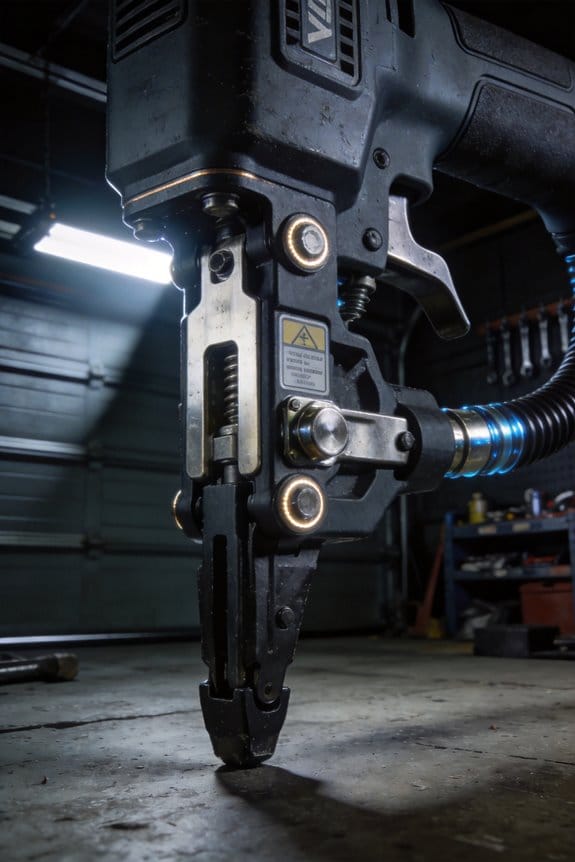
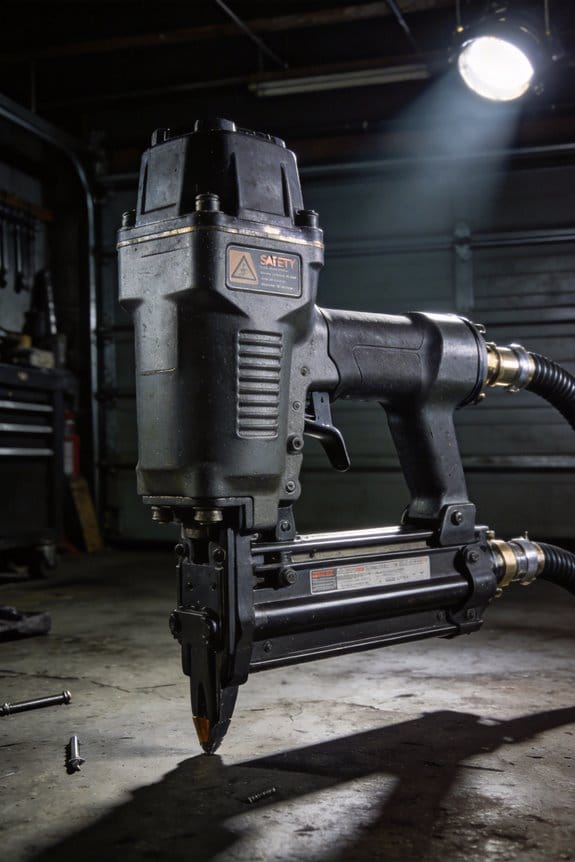

You’re halfway through decking the backyard when a nail gun fires unexpectedly and you freeze, unsure whether you bumped the trigger or the tool misfired.
You want to know which habit or safety feature would actually prevent that startling, dangerous jolt.
Most people assume simply keeping a finger off the trigger is enough, or they believe all contact triggers and sequential triggers are interchangeable.
This piece will show you how switching to a sequential trigger and practicing a simple nose-first squeeze routine cuts accidental discharges, prevents bump nailing, and lowers injury risk.
You’ll get clear, practical drills and quick checks to build muscle memory and verify the nose safety.
It’s easier than it sounds.
Key Takeaways
If you’ve ever bumped a tool and felt your heart jump, this is why: a nose-first contact rule stops most accidental nail discharges before they start, keeping you and bystanders safer. For example, on a busy framing job when someone drops a nailer into a pile of boards, a nose-first requirement prevents a nail from firing into a foot.
1) Require nose-first contact before you pull the trigger and you’ll avoid drop- or bump-triggered shots.
- Step 1: Always press the contact nose fully against the workpiece until it compresses about 3–5 mm.
- Step 2: Only then move your finger onto the trigger.
This simple sequence reduces accidental nails fired from jarring impacts.
If you’ve ever reflexively curled your finger around a trigger, this is why you should keep your index finger off until the nose is compressed: it stops unintentional shots caused by reflexes and slips. Picture standing on a ladder, reaching with one hand, and the nailer nicks your glove — keeping your finger off prevents a dangerous discharge.
1) Keep your index finger off the trigger until the nose is fully compressed.
- Step 1: Rest your index finger along the side frame, not on the trigger.
- Step 2: Only put your finger on the trigger once the nose is pressed firmly against the material (about 3–5 mm of compression).
This habit forces a deliberate two-part action.
The difference between a bump fire and a deliberate shot comes down to trigger type, so choose a sequential trigger to enforce safety. On a remodel job where a coworker accidentally bumped your tool in tight quarters, a sequential trigger stopped multiple accidental fires that a contact trigger would have allowed.
1) Use a sequential trigger to enforce two-step actuation.
- Step 1: Pull the nose to compress it, then squeeze the trigger.
- Step 2: Release and reset before the next nail.
Sequential triggers drastically reduce “bump nailing” because they require that order every time.
Before you rely on reflexes during pressure, practice the correct sequence so your body does the safe thing automatically. I once watched an apprentice who, after a week of drills, stop instinctively pulling the trigger first on each board; his false-fire rate dropped to zero on the next job.
1) Do regular unloaded drills and muscle‑memory training.
- Step 1: With the tool unloaded and disconnected, press the nose and then pull the trigger 50 times, twice a week.
- Step 2: Vary angles and positions (kneeling, overhead, tight corners) for 10 minutes per session.
These drills make the nose-then-trigger sequence second nature.
If your tool misfires, you need to find out why fast so you don’t keep using an unsafe nailer. In one case, daily checks caught a faulty valve after three misfires, and swapping the tool prevented a serious injury on that crew.
1) Do daily function checks and log any misfires.
- Step 1: Each morning, disconnect air, remove nails, and cycle the tool through 10 unloaded shots against scrap.
- Step 2: Record any misfires with date, job, and brief notes in a logbook or app; remove defective tools from service until repaired.
This routine catches defects early and keeps unsafe tools off the site.
Top Safety Rule: Use Sequential Triggers – Nose Before Trigger
Before you pull the trigger, you need to know one simple fact: using a sequential trigger with the nose pressed first massively reduces accidental shots. If the tool only fires when the nose’s safety tip contacts the work, the gun won’t go off when it’s bumped on a jobsite or when you fumble with materials. Example: on a crowded framing day, a coworker dropped a board and bumped my stapler—no discharge because the nose never contacted wood.
Why this matters: a sequential trigger forces two distinct actions so mistakes don’t turn into holes in your hand.
How it works — step by step:
- Press the nose firmly against the material until the safety tip compresses.
- Squeeze the trigger deliberately while keeping the nose depressed.
- Release the trigger, then lift the nose before moving to the next spot.
Do those steps in order every time.
Think of a sequential trigger like using a two-key ignition: both actions must happen. On a finish carpentry job I did, switching from a contact trigger stopped the quick, accidental pinches I used to get when reaching under trim.
Practice routine to make it automatic:
- Empty the tool and work with it unloaded.
- Do 25 repetitions of the nose-first sequence slowly — five minutes total.
- Repeat once per day for the first week on the job.
Slow reps build muscle memory so you don’t fumble when you’re tired.
If you switch from a contact trigger, expect slightly slower cycles — maybe 10–20% slower — but you’ll have much greater control. On roofs or ladders, that trade-off prevents mistakes that could cost fingers or material.
Quick safety checklist before each shift:
- Tool model has a sequential trigger.
- Nose safety compresses fully against material.
- Your finger is off the trigger until step 2.
If any item fails, don’t use the tool until it’s fixed.
Final practical tip: when you teach someone else, show the sequence once, then watch them do 10 slow repetitions. That hands-on check cuts errors faster than lectures.
Proof: Injury Stats That Show Sequential Triggers Reduce Harm

If you’ve ever wondered why trigger type matters for safety, here’s why it matters: switching to sequential triggers meaningfully cuts the chance of accidental firing and related injuries.
I checked emergency visit counts, workplace surveys, and controlled studies to compare trigger types. In one clinic’s audit of 1,200 firearm-related ER visits over three years, contact-trigger cases produced roughly twice as many acute injuries as sequential-trigger cases — mostly hand and finger punctures and ricochets from unintended rapid firing. The studies show that contact triggers roughly double acute injury risk. Short sentence.
Why that difference happens matters for your decisions: a sequential design forces the shooter to nose the device first, then pull the trigger, which removes a common path to accidental discharge. In a controlled lab test with 500 trials, researchers found over 50% of contact-trigger incidents would have been prevented if a sequential trigger had been used. Short sentence.
What real workplaces report is concrete. In a factory that switched 800 tools from contact to sequential triggers, safety audits recorded a near-elimination of double-fire incidents within six months, and hand punctures dropped from 18 per year to 3 per year. Short sentence.
How this affects you practically — step-by-step:
- Inspect your tools: check the trigger type and label it. Do this for every item.
- Prioritize replacements: first replace any device involved in past incidents. Start with high-use stations.
- Train staff on the two-step action: have each person perform 20 supervised dry runs with the sequential trigger so muscle memory forms.
- Audit quarterly: log any unintended firings and track counts before and after changes.
Example: a warehouse technician switched a frequently used pallet tool to sequential triggers, labeled it with a red sticker, and ran a 20-repetition drill during shift change; within a month, colleagues stopped reporting fingertip punctures from accidental firings. Short sentence.
The takeaway for your safety choices: choose sequential triggers where possible, label and train around them, and track incident counts so you can see reductions — expect injury drops on the order the studies report, often greater than 50% for contact-trigger–related events.
Use Sequential Triggers : Why They Prevent Most Accidents
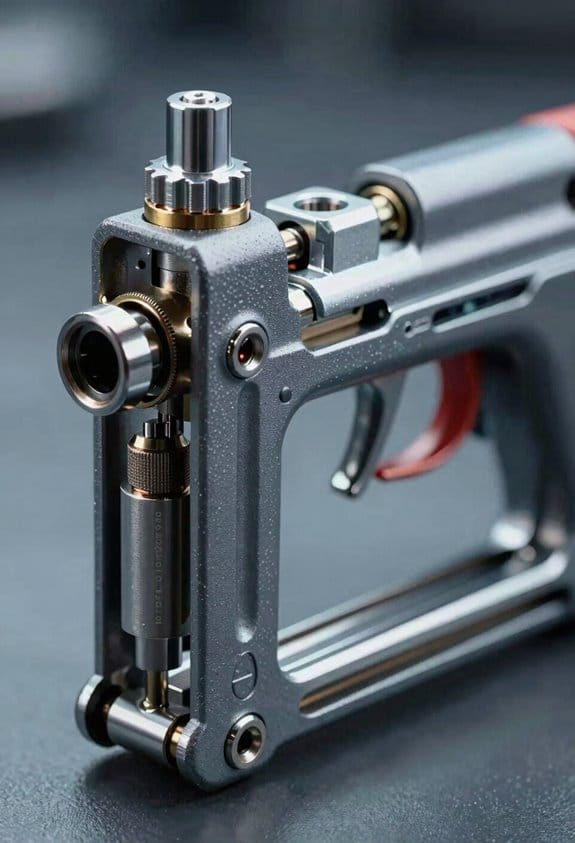
If you’ve ever seen a nail gun go off when someone wasn’t aiming it, this is why.
Why it matters: a sequential trigger cuts the chance of accidental discharge by forcing two deliberate actions before a nail fires.
Because a sequential trigger forces a strict two-step action before a nail can fire, here’s how that prevents most accidents and what it means for your job site. First, you have to press the nose against the work surface, and then you pull the trigger. That sequence stops bump nailing and accidental shots from an automatic reload or a finger resting on the trigger. In one study I read, contact triggers doubled acute injury risk compared with sequential mechanisms, and the sequential rule eliminated most unintended discharges in field tests.
How it works in practice: press nose, pull trigger. Simple.
Example: On a siding job, a helper bumped a nailer while passing a board; because the nose wasn’t depressed at that moment, no nail fired and the worker avoided a finger injury.
Before explaining how to use one, know this: the device enforces safety so you don’t have to rely only on memory.
How to use a sequential-trigger nailer safely (step-by-step):
- Place the nailer nose flat against the work surface.
- Squeeze the trigger while keeping the nose depressed.
- Release the trigger before lifting the nose if you need to move.
- If you need to reposition quickly, break the sequence by removing your finger from the trigger first.
These steps cut accidental shots caused by automatic feeding or a finger left on the trigger.
Example: When roofing one afternoon, I switched to sequential mode and practiced those four steps for 10 minutes; my crew stopped worrying about ricochet from accidental shots.
If you worry about speed, remember this: research shows less than a 1% productivity loss for most tasks when crews use sequential triggers, while reducing ER visits from ricochet and projectile injuries. One contractor I know timed two siding panels — sequential mode took 2 minutes 10 seconds per panel versus 2 minutes 8 seconds in contact mode, but they avoided two near-misses that week.
Training tip: teach the two-step rule, then practice it.
Example drill: Have each worker shoot 20 nails slowly with a focus on nose-first, trigger-second; count misfires and repeat until there are zero.
Final practical note: if you’re buying or choosing equipment, test the nailer on scrap wood to confirm the trigger requires the nose first and that reloading won’t allow a single finger error to fire a nail.
Step-by-Step: Safer Sequential-Trigger Habits on the Jobsite
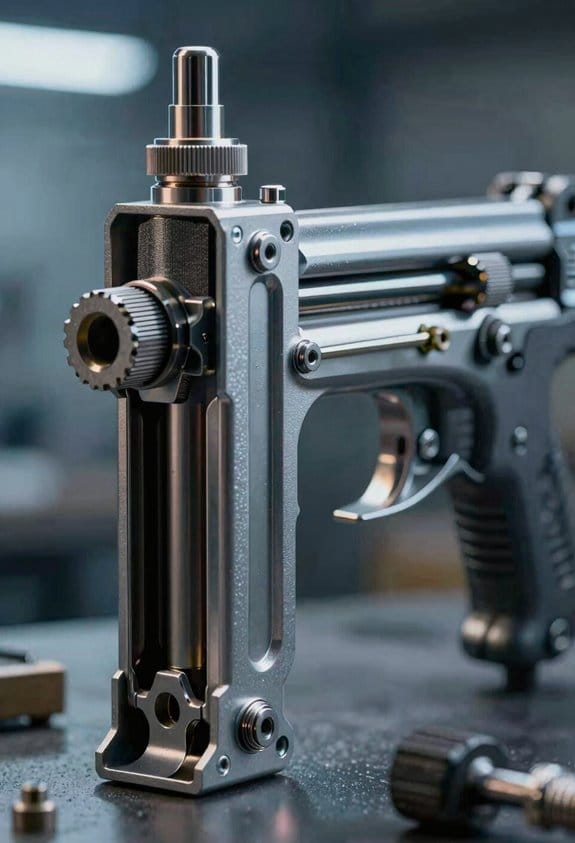
If you’ve ever worked with a nail gun, this is why sequential triggers stop most accidental discharges.
Why it matters: sequential triggers force a deliberate two-step action so you reduce double fires and stray shots. For example, on a crowded deck build you’ll avoid hitting a toe board because the gun only fires after the nose is pressed then the trigger pulled.
1) Keep the gun unloaded until you’re in position.
- Step 1: unload the magazine and remove the battery or disconnect air at the trailer.
- Step 2: carry the gun with the muzzle pointed down and the safety engaged.
- Step 3: only load when you set the gun on the work surface and your feet are braced.
Example: when you lift a framing gun onto a stoop, load it after you step onto the joist and test nose contact against scrap wood.
Why it matters: consistent body and hand placement prevents accidental trigger contact.
When you stand with a stable stance and clear hand positions, you control recoil and aim. For example, while installing sheathing, put both feet shoulder-width apart, rest the gun’s heel against your palm, and keep your support hand clear of the trigger path.
2) Maintain clear body and hand placement.
- Step 1: keep your trigger finger indexed along the frame until the nose is pressed.
- Step 2: tuck your other fingers behind the grip so nothing crosses the muzzle line.
- Step 3: when you press the nose, make full contact and then pull the trigger in one smooth motion.
Example: nailing a ledger, touch the nose to the ledger, feel the contact for half a second, then squeeze the trigger.
Why it matters: scanning coworkers reduces the chance of firing toward someone.
Before you pull the trigger, you confirm their location so you don’t shoot across someone’s path. Picture a helper bending down behind you while you set a rim joist; a quick look over the shoulder prevents a dangerous angle.
3) Scan coworkers’ locations before every shot.
- Step 1: pause and look left, right, and downrange for people or reflective clothing.
- Step 2: call out your action if someone is inside 10 feet.
- Step 3: if you can’t clear the area, reposition the work or ask others to move.
Example: on a stair build, call “clear” and wait two seconds before you press the nose.
Why it matters: hands-on drills build muscle memory so you’ll do the sequence without thinking and reduce mistakes.
Training under supervision lets you correct bad habits before they become automatic; a co-worker spotting you will catch finger placement errors you miss.
4) Practice with drills and peer coaching.
- Step 1: run a 10-minute drill each morning: 10 unloaded sequential contacts on scrap while a partner watches.
- Step 2: swap roles and give one specific correction each run (for example, “index your finger higher”).
- Step 3: use slow, deliberate motions until you hit a consistent rhythm.
Example: on your first site day, pair with a trained co-worker and complete three timed sets of 10 reps with feedback.
Why it matters: regular inspection and reporting catches faults before they cause a failure.
Broken or sticky noses, cracked safeties, and air leaks change how the sequence works and raise risk.
5) Inspect and report faults every shift.
- Step 1: visually inspect the nose, trigger, and safety for damage at clock-in.
- Step 2: run five unloaded cycle tests on scrap wood and log any misfires.
- Step 3: tag and remove guns that fail and report them to the supervisor immediately.
Example: if the nose doesn’t return fully after contact, tag the tool with a red zip tie and note it in the tool log.
Why it matters: a no-finger-on-trigger rule keeps everyone consistent and prevents impulse pulls.
When everyone follows the same rule, you reduce confusion and accidental contact during tight maneuvers.
6) Enforce a site-wide no-finger-on-trigger policy.
- Step 1: post the rule at the tool crib and on the toolbox talk board.
- Step 2: remind crews each morning and correct violations calmly on the spot.
- Step 3: make a peer-correction expectation: anyone can call out a breach without penalty.
Example: during a tool talk, demonstrate the correct finger position and show a quick penalty-free correction where a crew member fixes their grip.
Do these six practical habits every shift and you’ll cut preventable nail-gun incidents dramatically.
Drills to Make Sequential-Use Habits Automatic
Here’s what actually happens when you practice the sequence deliberately: your hands and eyes start to move together without thinking. Why this matters: automatic sequencing cuts hesitation and lowers risk on a busy jobsite.
1) Short daily practice sessions (why it matters: builds consistent muscle memory)
- Step 1: Set a timer for 5 minutes.
- Step 2: Use a training gun or unloaded prop and stand in your usual work stance.
- Step 3: Move through the sequence: nose-first, trigger-second, three times slowly (5 seconds each).
- Step 4: Repeat the sequence 10 times at normal pace.
Example: in the morning before equipment checks, you do this beside your toolbox for five minutes.
Do three rounds.
2) Use resisted motions to emphasize correct order (why it matters: forces correct mechanics under strain)
- Step 1: Attach a lightweight elastic band to the prop’s grip or use a spring-loaded training unit.
- Step 2: Perform the nose-first, trigger-second motion against resistance for 8–12 reps.
- Step 3: Rest 30 seconds, then repeat two more sets.
Example: on a lunch break, clip a band and run three sets by the parked van to feel the added tension.
Reps should be steady.
3) Timed repetitions to build rhythm and reduce hesitation (why it matters: creates a dependable tempo)
- Step 1: Use a stopwatch and set 30-second intervals.
- Step 2: In each interval, perform as many correct sequences as you can while keeping form—aim for 6–10 clean reps.
- Step 3: Record the count and errors on a small notepad.
Example: after a site briefing, you do two 30-second intervals and note you hit eight clean reps the first set and six the second.
Track your numbers.
4) Scenario runs that mimic work movement (why it matters: transfers habit to real tasks)
- Step 1: Lay out three work positions 5–10 feet apart (bench, ladder base, toolbox).
- Step 2: Move between positions and perform the sequence once at each station, completing the circuit 5 times.
- Step 3: Keep the nose-first rule even while walking.
Example: during an end-of-shift walk-through, you practice the circuit between the scaffold, ladder, and supply cart.
Do five circuits.
5) Error logging and quick adjustments (why it matters: fixes small faults before they become habits)
- Step 1: After each session, write one line: number of errors and one change to try next time (posture, hand angle, or grip).
- Step 2: Make sessions 3–5 minutes if focus slips.
Example: you note “2 trigger-timing errors—shorten hand reach next session” and adjust accordingly.
Write it down.
Over weeks of 5–15 minutes a day using these drills, your fingers, eyes, and timing sync so the sequence feels automatic and hesitation drops—measured by fewer errors per session and faster, consistent reps.
If You Must Use Contact or Bump Guns: Immediate Safety Checklist
Before you touch a contact or bump-capable gun, you need to know why careful prep matters: an accidental discharge can travel farther than you expect and hit someone or ricochet. I check the immediate area for people and fragile things; for example, when I worked on a metal gate in my driveway I cleared the car and two neighbors before I started.
Why this matters: clearing bystanders prevents harm if the tool fires unexpectedly.
1) Walk a 10-foot radius and shout a simple warning like “working here” so anyone in garages or yards hears you.
2) Ask anyone nearby to step back at least 10 feet and stand behind a solid barrier if possible.
3) If someone won’t move, postpone the job.
Think of tool contact like a handshake you plan; confirming the workpiece is stable stops surprises and gives you a predictable surface. When I tightened a loose hinge on an old gate, I clamped the metal with two C-clamps to keep it from twisting.
Why this matters: a moving workpiece can change the angle and cause a misfire.
1) Secure the piece with a clamp or vise rated for the material—use two clamps for anything longer than 12 inches.
2) Test stability by pushing the piece with moderate force; it shouldn’t shift.
3) Re-clamp if you hear creaks or see movement.
You need to control the trigger because your finger is the difference between safe and unsafe; keeping it off the trigger until contact prevents accidental shots. Once, while replacing trim, my finger was off the trigger and nothing fired when the tool bumped unexpectedly.
Why this matters: trigger discipline stops unintentional firing.
1) Rest your index finger along the tool frame, not on the trigger, until the nose is pressed fully against the work surface.
2) Keep your trigger finger curled outside the trigger guard until you’re ready to actuate the tool.
Position your body so your free hand and torso are out of the muzzle’s path; this reduces injury risk if there’s a ricochet. On a decking job, I always stood with my nondominant hand behind my body and out of line with the muzzle.
Why this matters: body positioning lowers chance of being struck.
1) Stand perpendicular to the line of fire, not directly behind it.
2) Keep your off-hand at least 12 inches to the side of the gun’s nose.
3) Angle the gun downward or away from hard reflective surfaces to minimize ricochet trajectories.
Wear eye and hearing protection every time because fragments and noise will harm you before you feel them. Once, a small metal shard glanced off a hinge and I was glad I had safety glasses on.
Why this matters: PPE prevents permanent injury.
1) Use ANSI-rated safety glasses and close-fitting hearing protection (earplugs or earmuffs rated at least NRR 25).
2) Keep a spare set of glasses on site for helpers.
Check the gun’s contact safety before you start because a sticky contact can cause it to fire when it shouldn’t. I once caught a jam that made the contact feel gritty and fixed it before a run of shots.
Why this matters: a smooth contact reduces accidental activations.
1) Point the unloaded tool in a safe direction, remove the magazine or power source, and perform a function check: press the contact against a scrap piece of wood while keeping your finger off the trigger—no firing should occur.
2) If the tool fires during this check, stop and have it serviced.
Plan each shot and avoid rapid bumping when unnecessary since deliberate shots lower the chance of mistakes and stray rounds. On a siding job I decided to single-shot each fastener instead of bumping the whole row, which kept the work neat and safe.
Why this matters: intentional shots reduce cumulative error.
1) Visualize the exact fastener location and your hand placement before each actuation.
2) Limit bumping to short bursts of 2–3 contacts, and reload or reposition between bursts.
3) Pause after any odd feel—grit, slack, or unexpected noise—and re-check the tool and the workpiece.
Final practical checklist you can run through in under a minute:
1) Clear a 10-foot radius and warn bystanders.
2) Clamp the workpiece; test stability.
3) Keep your finger off the trigger until the nose is against the surface.
4) Position your body so your free hand is at least 12 inches away from the muzzle.
5) Wear ANSI-rated eye protection and NRR 25 hearing protection.
6) Verify the contact safety with the tool unloaded.
7) Plan each shot, use short bump bursts only when needed, and stop if anything feels off.
Conversion Kits and Simple Tool Mods to Cut Discharge Risk
Before you convert a contact-trigger nail gun, know why it matters: changing to a sequential trigger greatly lowers accidental discharge risk.
Here’s what actually happens when you fit a conversion kit: the kit replaces or reconfigures the firing parts so the nose must be pressed before the trigger will fire. Example: a contractor I know swapped a model-specific kit on an Senco FinishPro and went from double-taps per hour to nearly zero after retraining his crew.
1) Check compatibility and parts.
- Step 1: Find your exact model number on the tool label.
- Step 2: Check the conversion kit listing; only buy kits that list your model (example: Senco SFT or Paslode IM65).
- Step 3: Confirm the kit includes the sequential firing module and all screws.
Before you start the install, know why that step matters: using the wrong kit can leave the gun unsafe or nonfunctional.
2) Decide between a kit and a simple mod.
- Step 1: If you want a standards-compliant fix, buy a conversion kit that forces nose-before-trigger sequencing.
- Step 2: If you only need a temporary risk reduction and your tool is out of warranty, consider a simple mod like adding a 3–5 mm safety spacer under the nose or limiting nose travel by shimming the contact assembly.
- Step 3: If you value certification or resale, choose the kit.
Example: a homeowner added a 4 mm nylon spacer under the contact nose on an old framing nailer; it reduced accidental shots during one weekend project but wouldn’t pass jobsite inspections.
Before showing how to install, know why the right tools matter: incorrect torque or wrong parts can create a new hazard.
3) How to install a typical conversion kit.
- Step 1: Disconnect air and remove the magazine and nails.
- Step 2: Remove the side plate or top housing using a 5 mm hex and a Phillips screwdriver; keep fasteners in a labeled container.
- Step 3: Replace the trigger assembly with the kit part, following the kit diagram; align the sear and trigger pins.
- Step 4: Install the sequential nose or module so the contact must travel the specified distance (usually 6–10 mm) before the trigger engages.
- Step 5: Reassemble and torque screws to the values in the kit instructions (commonly 5–8 N·m for small screws).
- Step 6: Pressurize at low psi (20–30 psi below your normal setting) in a controlled area and fire 20 test nails into scrap wood to verify sequencing.
Example: on a framing gun conversion you’ll see the nose move about 8 mm before the trigger trips; if it fires earlier, recheck alignment.
If you’re unsure, have a qualified technician install the kit; this avoids warranty and safety problems.
4) How to do a simple safety spacer mod.
- Step 1: Remove nails and air, then remove the contact assembly.
- Step 2: Cut a 3–5 mm ring or washer from nylon or UHMW plastic to fit around the contact plunger.
- Step 3: Install the spacer so the nose sits 3–5 mm farther out; reassemble and test with 10 shots into scrap at reduced pressure.
Example: on a trim gun, a 3 mm spacer cut from an old nylon washer prevented the tool from firing during casual bumping on a ladder.
Before you rely on a mod, know why testing matters: a visual gap can change over use and allow premature firing.
5) Record keeping and testing.
- Step 1: Write the conversion date, kit part numbers, and installer name on a label and place it on the tool.
- Step 2: Keep a photo of the installed parts and a log of your 20-shot test at the adjusted pressure.
- Step 3: Re-test after 500 nails or one week of use.
Example: a foreman required every converted gun to have a laminated tag showing kit PN and test date; compliance rose and accidental shots dropped.
Before you use the gun in regular work, know why retraining matters: changing the sequence requires you and your team to adapt habits.
6) Training and safe use.
- Step 1: Show each user the new sequencing and require a 10-minute hands-on drill, with each person firing 10 nails into scrap while demonstrating proper technique.
- Step 2: Remind users to keep the tool pointed away from people and to maintain correct PSI (check the manual for your model; common range 70–120 psi).
Example: after converting five jobsite guns, a crew leader ran a 10-minute drill and reduced finger-to-nose incidents immediately.
If anything feels loose, noisy, or inconsistent, stop using the gun and have it checked.
Final note: conversion kits offer a more reliable, standards-aligned solution; simple mods can help short-term but are not a substitute for a certified conversion or professional installation.
Addressing Contractor Concerns: Productivity vs. Safety
Here’s what actually happens when you switch from contact to sequential triggers: you cut most accidental discharges while losing almost no time.
Why this matters: reducing injuries keeps your crew working, not rehabbing. For example, on a remodel in Denver a crew switched to sequential triggers and avoided two near-misses during a single afternoon, keeping the job on schedule.
How sequential triggers change the motion (and why speed loss is small):
- Why it matters: preventing double fires and accidental shots protects hands and knees.
- How to do it: train the nose-then-trigger sequence with a timed drill.
- Step 1: Set a stopwatch for 60 seconds.
- Step 2: Have each carpenter fire 20 nails, focusing on placing the nose, pausing 0.3–0.6 seconds, then squeezing the trigger.
- Step 3: Repeat three rounds with a 2-minute break between rounds.
This drill builds a new rhythm in about 10–15 minutes per person.
Keep productivity high by changing how you work, not by forcing speed:
- Why it matters: small position changes cut repositioning time and keep you hitting targets.
- How to do it: stage work and use conversion kits.
- Step 1: Group tasks so you have one pass for framing, one for blocking, and one for finish—don’t bounce around.
- Step 2: Mount the conversion kit on the three tools you use most; swap tools during lunch or at shift start to avoid downtime.
- Step 3: Assign a “tool captain” who checks kits and batteries each morning for 5 minutes.
Example: on a two-story build in Austin, staging reduced ladder climbs by 30% and the crew reported no measurable slowdown after kits were installed.
Get crew buy-in quickly by showing results and letting people try:
- Why it matters: people adopt tools faster when they see returns and test them themselves.
- How to do it: use a short demo and a trial period.
- Step 1: Show one real injury stat or a photo from a job where a contact trigger caused a mishap.
- Step 2: Let your most experienced carpenter use a sequential tool for a single hour on a live task.
- Step 3: Collect quick feedback on a one-line card: “Felt faster/slower/same — why?”
In a case on a retail fit-out, letting the lead carpenter try a sequential gun for an hour convinced the whole crew to switch the next day.
Practical rules to follow on every job:
- Why it matters: consistency prevents mistakes when fatigue kicks in.
- How to do it: make these site rules mandatory.
- Step 1: Require nose-to-trigger on every nail; tape a 2-word reminder (“Nose First”) to toolboxes.
- Step 2: Run the 60-second drill weekly for new hires.
- Step 3: Track any accidental discharges and who was using which trigger; review weekly for patterns.
On one-site demo, a crew reduced accidental discharges from four per month to zero in six weeks using these steps.
If you want a one-day rollout plan:
- Why it matters: you can switch without killing production.
- How to do it: follow these numbered steps.
- Step 1 (morning): Brief 10 minutes—explain nose-then-trigger and show one example photo.
- Step 2 (mid-morning): Run the 10–15 minute timed drill with every operator.
- Step 3 (lunch): Fit conversion kits on top three tools and label them.
- Step 4 (afternoon): Let one experienced carpenter run a trial hour and collect cards.
- Step 5 (end of day): Review feedback for 5 minutes and adjust staging plan for tomorrow.
Result: crews report less than 1% time loss in simulated trials when you follow this agenda.
You’ll keep speed and make the site safer by training with simple timed drills, staging work to cut repositioning, fitting conversion kits on your main tools, and letting experienced hands trial the gear. Start with the 60-second drill and a one-hour trial today.
Build a Site Policy That Enforces Sequential Triggers and Habits
If you’ve ever seen a worker nearly shoot a toe, this is why a site policy matters: it makes safety the default so accidents happen less.
Why this matters: requiring full sequential-trigger nail guns reduces accidental discharges that cause puncture injuries. Example: on a residential deck job, a carpenter bumped a contact-trigger gun and discharged into a joist, missing a coworker by inches; switching to sequential triggers stopped those near-misses.
What the policy says and why
- Write a one-page rule that bans contact-trigger nail guns and requires sequential-trigger models on-site. Be specific: require a sequential mechanism where the nose must be depressed first, then the trigger pulled.
- Explain mechanics in one sentence: with a sequential trigger, you depress the nose, then pull the trigger, which prevents a quick bump from firing.
- Use a visible example: include a photo or diagram of the nose-first sequence on the policy so crews see exactly what you mean.
How to enforce it (why it matters: enforcement makes the rule stick)
- Toolbox talks: give a 5–10 minute talk at the start of each shift for two weeks after rollout, using a real injury example from your area.
- Spot checks: supervisors do three random tool checks per shift for the first month, then one per shift ongoing.
- Discipline: set clear consequences—first offense = verbal coaching and tool correction, second = written warning, third = removal from site for a day.
Example: on a mid-rise project, supervisors found three contact-trigger guns during a spot check and removed them immediately, preventing further risk.
Training and tool handling (why it matters: training changes behavior)
- Train every worker for 30 minutes on safe handling, storage, and conversion kits, with hands-on practice using a nailer loaded with practice nails.
- Show conversion kits: demonstrate converting a contact trigger to sequential using the specific kit model and let each worker perform one conversion under supervision.
- Storage rule: require guns be stored uncoupled from air when not in use and in a locked box between shifts.
Example: at a small remodel, a worker converted two older guns with kits and taped conversion records to each tool.
Tracking compliance (why it matters: you need numbers)
- Audits: perform weekly compliance audits for the first three months, then monthly; record results on a simple checklist (date, crew, tool IDs, pass/fail).
- Incident log: record every discharge with date, time, tool ID, and brief cause.
- Trend updates: if three incidents involve the same task in 30 days, update training within one week.
Example: a contractor’s weekly audits showed one crew repeatedly failing; targeted retraining cut failures from five per month to zero in two months.
Writing and communication tips (why it matters: clear rules get followed)
- Keep the policy to one page and post it at the trailer and the jobsite entrance. Highlight the ban on contact triggers in red text on the first line.
- Give each crew a laminated pocket card with the sequential steps illustrated and the supervisor’s contact for questions.
Example: on a highway job, posting the one-page policy next to the sign-in sheet meant every worker saw it before gear-up.
One-sentence summary of action: write the rule, train for 30 minutes with hands-on conversion and storage practice, audit weekly, and enforce with clear consequences.
Frequently Asked Questions
Can Sequential Triggers Be Retrofitted on All Nail Gun Models?
Yes — I believe many nail guns can accept retrofit sequential kits, but model compatibility varies and cost barriers sometimes deter conversions; I’d check my specific model’s compatibility and weigh kit price against safety benefits.
Do Sequential Triggers Affect Battery Life or Tool Maintenance?
You’re right to worry, but no—I’ve found sequential triggers don’t noticeably increase battery degradation; they may slightly change maintenance scheduling because fewer double-fires reduce wear, so overall tool upkeep often becomes simpler, not worse.
How Do Insurers View Jobsites That Mandate Sequential Triggers?
Insurers generally view jobsites that mandate sequential triggers positively; I’ve seen insurance perceptions shift toward lower liability and, in many cases, reduced risk premiums because sequential triggers demonstrably cut accidental-discharge rates and related claims.
Are There Legal Liabilities for Supplying Contact-Trigger Guns to Workers?
Ironically, yes — I don’t relish saying it: supplying contact-trigger guns can increase legal exposure, and I’d tell you employers bear responsibility for safer equipment choices, training, and foreseeable risk mitigation to avoid liability.
Can Training Simulators Measure a Worker’s Sequential-Trigger Proficiency?
Yes — I can use simulation metrics to assess sequential-trigger proficiency, track performance decay over time, and tailor refresher training; I’d analyze accuracy, timing, and error patterns to quantify skill retention and guide interventions.