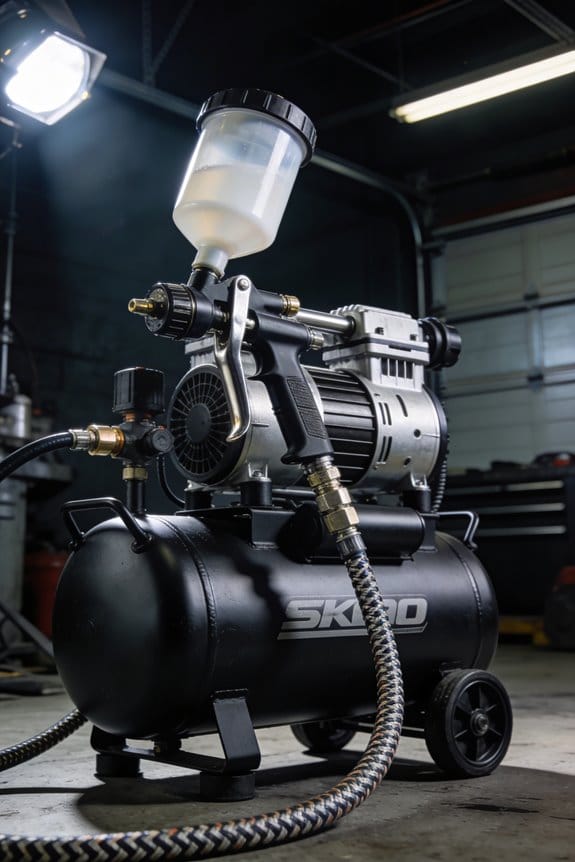

You start a spray pass and the finish looks chalky and coarse, or the gun sputters halfway through a session — you know something’s off but can’t pin it down. The exact problem is whether your compressor can actually deliver the gun’s required CFM at the PSI you’re running, not just the compressor’s headline specs. Most people blame the gun, the paint, or technique when the real issue is airflow and pressure losses.
This article will show you how to check CFM at working PSI, find leaks and restriction points (tank, hose ID, fittings, regulator), and fix them so your atomization and pattern return to normal. You’ll get clear, actionable steps to stop orange peel, runs, and sputtering. It’s easier than it looks.
Key Takeaways
If you’ve ever watched a paint job go bad, this is why.
Why it matters: uneven spray wastes paint and time and can ruin a finish in minutes.
Example: on a car door, your pattern starts tearing at the edges and you get orange peel across the panel — that’s classic low-CFM symptom right before runs appear.
1) Low CFM at your gun PSI — what happens and how to check
Why it matters: low CFM makes your pattern break up, sputter, and atomize inconsistently.
Example: spraying a primer with the gun set at 40 PSI but the compressor can’t keep up; you’ll see the fan open and close while the trigger’s pulled.
Steps:
- Measure: set your regulator to the gun’s recommended PSI (for many HVLP guns that’s 20–40 PSI) and hold the trigger while watching the gauge or a flow meter.
- If pressure drops more than 5–10 PSI while spraying, your compressor CFM is too low.
- Fix options: use a compressor that delivers the gun’s required CFM at the operating PSI, or lower the gun’s fluid setting to reduce air demand.
2) Small tanks and short duty-cycle motors — why cycling ruins your spray
Why it matters: frequent motor starts change pressure and make the spray pulse.
Example: a 1.5 HP pancake compressor with a 2-gallon tank cycles every 20–30 seconds during a medium-size trim job and the pattern pulses visibly.
Steps:
- Watch tank pressure while you spray; note how fast it falls and how often the motor starts.
- If the motor runs constantly or cycles every 20–60 seconds, increase tank capacity (get a 20–30+ gallon tank for steady work) or use a compressor with a higher duty cycle.
- For handheld or short runs, add an inline storage tank (5–10 gallons) between compressor and gun to smooth pressure.
3) Hoses, fittings, and distance — how line size kills delivered CFM
Why it matters: undersized or long lines drop pressure and reduce the CFM that actually reaches your gun.
Example: running 50 feet of 1/4″ hose from the compressor to the gun leaves you with noticeably weaker spray compared with a 25-foot 3/8″ hose.
Steps:
- Use the right hose diameter: 3/8″ minimum for short runs up to 25 feet, 1/2″ for longer runs or higher-flow guns.
- Keep fittings and quick-connects to a minimum and use 3/8″ or 1/2″ fittings to match the hose.
- Cut long runs short when possible; every 10–20 feet of extra hose costs you a few percent of CFM.
4) Pump displacement vs. FAD — pick the right spec
Why it matters: pump displacement overstates what you actually get at the gun, so pick compressors rated in FAD (Free Air Delivery).
Example: a pump labeled 6 CFM displacement might only deliver ~4 CFM FAD, so your gun that needs 5 CFM won’t run properly.
Steps:
- Look for FAD ratings when buying; if only displacement is listed, multiply displacement by 0.7 (the inverse of the 140% rule) to estimate FAD.
- For safety, apply the 140% rule: buy a compressor with a displacement equal to your needed FAD × 1.4 so the real FAD meets demand.
- Match the compressor FAD to the gun’s required CFM at the gun’s working PSI, not just the maximum pressure.
5) Watch tank pressure during spraying — specific thresholds and fixes
Why it matters: pressure drops greater than 10 PSI mean your system can’t keep up and finish quality suffers.
Example: you set 40 PSI, trigger, and see the gauge drop to 29 PSI while you spray; that’s a red flag before runs and uneven texture.
Steps:
- Monitor: with the gun held open, note how many PSI the tank loses after 5–10 seconds.
- If pressure falls >10 PSI, address supply: increase compressor size, add tank volume, or upsize hoses to reduce pressure loss.
- Quick fixes: spray in shorter bursts, close the regulator slightly to lower gun demand, or move closer to the compressor to shorten hose length.
Final quick checklist you can use before you start spraying:
- Confirm gun CFM required at operating PSI.
- Verify compressor FAD meets that CFM (or buy displacement × 0.7 if needed).
- Use at least 3/8″ hose for short runs, 1/2″ for long runs.
- Aim for a 20–30 gallon tank for continuous work; add an inline tank for portability.
- If tank pressure drops >10 PSI while spraying, upgrade pump, tank, or hose.
What This Guide Solves (Quick Answer and Who It’s For)
If you’ve ever sprayed a panel and watched the finish turn blotchy or run, this is why.
Why this matters: uneven atomization and pressure drops ruin finishes and waste material. I’ll show you exactly how to match your compressor and tank to your spray gun so pressure stays steady and your coats stay even.
What you’ll learn and who this is for:
- How to size compressor output: aim for a continuous CFM at working PSI that matches your gun. Example: a 1.3 mm HVLP gun typically needs about 10–14 CFM at 40 PSI. If your compressor only gives 5 CFM at that pressure, expect sputtering.
- How tank size helps: use a buffer tank that holds enough air to avoid short cycling. Example: for the gun above, a 20–30 gallon tank evens out demand during a 5–10 second trigger pull.
- Why hoses and fittings matter: use 3/8″ ID hose or larger for runs under 25 feet; use 1/2″ ID if you run over 25 feet or have multiple guns. Smaller hoses drop pressure fast.
- What PSI vs. CFM means in practice: PSI is the pressure you set at the gun; CFM is how fast the compressor must deliver air. Keep your working PSI steady; that’s how atomization stays consistent.
- How duty cycle and heat affect performance: if your compressor has a 50% duty cycle, you can run it 3 minutes out of 6. Example: a 5 HP shop compressor with 50% duty and 20 CFM will overheat if you run continuous 15 CFM tasks without a larger tank.
- Practical steps you can take right now:
- Check your gun’s CFM at the PSI you use. Compare to the compressor’s continuous CFM spec.
- Add a buffer tank sized to keep pressure drops under 5 PSI during a trigger pull. Start with 20–30 gallons for single-gun hobby use.
- Upgrade hoses to 3/8″ or 1/2″ ID and use quick-connects rated for your PSI.
- Set compressor regulators so the receiver pressure is 10–15 PSI above your gun setting.
- Schedule oil checks and filter changes every 50 hours for small shops; every 200 hours for commercial units using full synthetic oils.
- Mount the compressor on rubber isolators and bolt the tank to reduce vibration and noise.
– Who should read this: you if you’re a hobbyist moving up from small pancake tanks; you if you’re a pro picking a shop compressor; you if your finish is inconsistent and you want predictable results.
Real example: a friend upgraded from a 6-gallon pancake to a 20-gallon receiver plus a 2.5 HP compressor. He replaced a 1/4″ hose with 3/8″ and set the regulator to keep 40 PSI at the gun; his mottling and orange peel disappeared on the first panel.
Read this so you can prevent pressure drops, avoid motor overload, and get repeatable spray patterns.
How CFM Shortfalls Ruin Spray-Gun Atomization
If you’ve ever watched a spray gun start to spit mid-pass, this is why.
Why it matters: poor atomization gives you a rough, uneven finish that shows under light and requires sanding and re-spraying.
When your compressor can’t supply the gun’s required free-air CFM, the air volume drops as soon as you pull the trigger, so droplets get bigger and the pattern breaks up; I’ve seen a 1.4 HP pancake compressor with a 2.0 CFM rating make a 1.8 CFM HVLP gun sputter and leave orange-peel texture on a car door. That thicker spray also piles material at the nozzle, which increases the chance of a clog and forces you to stop and clean mid-job. Use a compressor that delivers at least 20–30% more free-air CFM than your gun needs — for a gun that needs 4.0 CFM, aim for 5.0 CFM delivered — and you’ll keep the spray fine and even.
How to check and fix it:
- Check your numbers: write down the gun’s CFM at your working pressure (e.g., 10–12 psi for HVLP).
- Measure or confirm compressor free-air CFM at tank pressure, not the manufacturer peak rating; many small compressors list inflated numbers.
- Match with margin: choose a compressor whose CFM exceeds the gun demand by 20–30%.
- Optimize hoses: use at least 3/8″ ID hose for short runs under 25 feet, and 1/2″ ID if you need longer runs; shorter, wider hoses reduce pressure and volume loss.
- Manage duty cycle: if your unit cycles frequently, pause between passes to let the tank recover, or upgrade to a larger tank (e.g., from 4 gallons to 20 gallons) to smooth airflow.
Real-world example: I once prepped a kitchen cabinet set with a 1/3 HP job-site compressor and a 1.6 CFM finishing gun; the gun kept sputtering and left blotchy edges until I switched to a 6-gallon, 3.0 CFM compressor and used a 1/2″ hose — the finish went from bumpy to smooth in one panel.
Final practical tip: if you see pattern breakup, measure tank pressure during a trigger pull — a drop of more than 10 psi means your CFM is too low.
Why Compressor PSI Stability Matters for Even Coverage
Why does PSI stability matter for spray finish?
If your compressor can’t hold steady PSI, your finish will swing from smooth to patchy fast — and uneven coverage will force you to sand and recoat. For example, spray-painting a kitchen cabinet door, a 5–10 PSI drop mid-pass will make the edge look glossy while the center goes dry.
When you spray, pressure controls droplet size, which controls atomization; unstable PSI changes droplet size and creates runs or dry spots.
How does PSI instability change the spray pattern?
You need steady air and fluid ratios so the nozzle produces an even mist; when pressure jumps, the pattern shifts shape and width. Picture spraying a metal toolbox: a sudden 5 PSI spike narrows the fan and throws more paint in one strip, leaving thin areas beside it.
- PSI up = smaller droplets, sometimes runs.
- PSI down = larger droplets, more orange peel and dry spots.
End with a concrete detail: check for pattern change over a 12–18 inch sweep.
What causes pressure to swing?
Leaks, undersized hose, weak regulator, and the compressor cycling under load all cause PSI swings. I once watched a job where a 3/8″ hose feeding a 1/2″ gun cut pressure during long passes, and the finish went blotchy after 10 minutes.
- Measure hose ID: use at least 1/2″ ID for HVLP or airless setups when run lengths exceed 25 feet.
- Inspect fittings: tighten or replace any with a visible air hissing sound.
- Check regulator: set it to the job PSI and watch the gauge while pulling the trigger.
How do temperature and paint properties affect why PSI control matters?
You care because air density and paint viscosity change with temperature, so the same PSI will spray differently over time; on a hot day a paint thins and atomizes more at the same pressure, which can make runs. Spray a metal gate at 85°F and you’ll need 3–5 PSI less than at 60°F to get the same pattern.
Give this example: when I painted a fence at noon, a 4°F rise in ambient plus hot metal made me drop pressure 4 PSI and slow my passes.
How to keep PSI steady — practical steps
You want predictable pressure; do these exact things.
- Choose the right hose:
- Use at least 1/2″ ID air hose for runs under 50 ft; use 3/4″ for longer runs.
- Walk the line, listen for hissing, and replace cheap quick-connects.
- Install a 2–5 gallon receiver tank or a larger regulator bowl to smooth short drops.
- Aim for 5–10 PSI above the spray setting so the unit cycles less often.
- Watch the gauge while spraying a 12–18 inch test panel every 10–15 minutes.
- Why this matters: FAD tells you the air you’ll actually have at the hose, which determines whether your gun will spray consistently.
- Steps:
Example: on a 20-foot booth line, switching from 3/8″ to 1/2″ hose, adding a 3-gallon tank, and raising cutoff by 7 PSI eliminated visible pressure sag.
What to expect after you fix PSI instability
You’ll get consistent droplet size and a stable fan pattern, which means fewer passes and less sanding. Expect a noticeable reduction in orange peel and runs when your PSI stays within ±2 PSI of the set point during a pass.
How to Size a Compressor (Displacement CFM, Free Air, 140% Rule)
Before you size a compressor, you need to know why the rules exist: they make sure your tools run reliably without the compressor short-cycling or starving for air.
Here’s what actually happens when you pick a compressor: the pump’s rated displacement CFM is the theoretical air moved, but the useful air at your tank and tool—Free Air Delivery (FAD)—is lower after losses, and you should size to about 140% of your tool demand so the system has margin.
1) How to get from displacement CFM to Free Air Delivery (FAD)
- Find the pump’s displacement CFM on the spec sheet (for example, 20 CFM).
- Multiply by 0.67 to estimate FAD (20 × 0.67 = 13.4 FAD). This subtracts roughly one‑third for realistic losses.
- Check the manufacturer FAD if provided, and prefer that number over your estimate.
– Example: You buy a pump listed at 15 CFM; estimate FAD = 15 × 0.67 = 10.05 CFM, so plan on about 10 CFM at the tank.
2) How to calculate your tool demand
- Why this matters: total tool demand tells you how much usable air you need at once, so you don’t undersize the compressor.
- Steps:
- List every tool and the CFM each needs at your working pressure (for example: HVLP gravity gun = 12 CFM @ 40 PSI, detail gun = 4 CFM @ 40 PSI).
- Add them when you plan to run tools simultaneously (12 + 4 = 16 CFM).
- Round up to the next whole number to avoid marginal fits.
– Example: Running two HVLP guns (12 CFM each) and a blow-off nozzle (3 CFM) means 27 CFM total demand.
3) How to apply the 140% rule and pick a compressor
- Why this matters: the 140% buffer covers leaks, pressure drop, and future needs so your compressor doesn’t run constantly.
- Steps:
- Take your total tool demand (for example, 16 CFM).
- Multiply by 1.4 (16 × 1.4 = 22.4 CFM). This is the FAD you should target.
- Choose a pump whose FAD (manufacturer number or your displacement×0.67) meets or exceeds that 22.4 CFM.
– Example: If you need 22.4 FAD, pick a pump with displacement ≈ 33 CFM because 33 × 0.67 ≈ 22.1; round up to 35 CFM pump to be safe.
4) Motor sizing and duty cycle
- Why this matters: the motor must run without overheating from frequent starts and long run times.
- Steps:
- Choose a motor rated for continuous or at least the expected duty cycle (e.g., 50% duty means 30 minutes on, 30 minutes off).
- For frequent starts or heavy-duty shop use, select a motor with a service factor or higher continuous rating—typically 10–20% above nominal.
- Confirm the electrical supply (voltage/phase) matches the motor nameplate.
– Example: A compressor with a pump that needs a 10 HP equivalent load should get a 12 HP motor or a 10 HP motor with a 1.15 service factor for heavy use.
5) Air treatment and filtration
- Why this matters: clean, dry air prevents ruined finishes and protects valves and fittings.
- Steps:
- Install a primary dryer or refrigerated dryer sized for your average CFM (match dryer rated CFM to your working FAD).
- Add a 5‑micron particulate filter after the dryer and a 0.01‑micron coalescing filter if you need near‑dry air.
- Use a regulator and secondary filter at each spray station to control pressure and capture any residual moisture.
– Example: If your working FAD is 25 CFM, buy a refrigerated dryer rated for at least 25 CFM and a 5‑micron filter with the same flow rating.
Quick checklist before you buy:
- Add every tool’s CFM for simultaneous use.
- Multiply that total by 1.4 to get target FAD.
- Use pump displacement × 0.67 (or manufacturer FAD) to compare to target FAD.
- Pick a motor rated for your duty cycle with a small service factor.
- Match dryer and filter ratings to your working FAD.
If you follow those steps, you’ll pick a compressor that actually supplies your tools, stays reliable, and gives you room to grow.
How Tank Size and Duty Cycle Affect Continuous Spraying

If you’ve ever run a spray gun on a long job, this is why tank size and duty cycle matter: they determine whether you get a smooth, continuous spray or frequent sputters.
Why this matters: inconsistent pressure ruins finishes and wastes time. For example, spraying a 4×8′ cabinet door with a 1‑quart HVLP cup will force you to stop every few minutes to refill and re‑pressurize, which causes uneven coats.
Match tank capacity to your spray pattern and draw:
1) Figure your gun’s peak CFM draw (check the manual — many HVLP guns pull 8–12 CFM, some airless systems pull 15–20 CFM).
2) Choose a tank that gives at least 10–15 seconds of buffer at that CFM before the compressor motor needs to catch up. For an 8 CFM gun, aim for a 6–10 gallon tank to smooth pressure during trigger pulls.
3) If you’re spraying a large continuous surface (for example, a door or a 10′ fence panel) pick the larger end of that range so you avoid short pressure dips.
Why this matters: the compressor’s duty cycle controls how long the motor can run without overheating and how often it will switch on and off. On a unit with a 25% duty cycle, the motor can run 15 minutes out of each hour at rated output before it needs rest, so continuous spraying leads to frequent shutdowns and lower effective airflow.
Practical duty-cycle steps:
1) Check the compressor rating — a 50% duty cycle means 30 minutes on per hour at rated load.
2) For continuous spraying, choose 50% duty cycle or higher; for multi-hour sessions, pick 80–100% duty cycle or a model rated for continuous use.
3) If you only have a low duty cycle unit, plan work in 10–20 minute bursts and let the motor cool between runs.
Why this matters: heat shortens motor life and reduces sustained airflow. An overheated compressor will deliver lower PSI and CFM and may force you to sand or thin coats to compensate.
Thermal management tips:
1) Position your compressor in a cool, ventilated spot and keep intake filters clean.
2) Use a larger tank or a secondary receiver to lower the number of motor cycles per hour; for example, adding a 20‑gallon receiver to a portable 6‑gallon tank halves the number of motor starts when spraying a 12 CFM tool.
3) Consider an aftercooler or forced-air fan on long jobs.
Putting it together — a practical example:
1) You’re spraying two kitchen cabinet doors (each 24″x30″) with an HVLP gun rated 10 CFM.
2) Choose a compressor with at least a 10‑CFM delivery and a 50% duty cycle; pair it with a 10+ gallon tank.
3) That combo gives you 10–15 seconds of buffer per trigger pull, fewer motor starts, and steady pressure for even coats.
Quick rules of thumb:
- Small intermittent jobs: 2–6 gallon tank, duty cycle ≥25%.
- Medium jobs (doors, cabinets): 8–12 gallon tank, duty cycle ≥50%.
- Large continuous work (walls, fencing, production runs): 20+ gallon tank, duty cycle ≥80% or continuous‑rated compressor.
Follow these steps, and you’ll get steadier spray patterns, fewer interruptions, and less wear on your compressor.
Pressure Drop in Spray Setups: Hoses, Fittings, and Distance
If you’ve ever stood at the spray gun and wondered why the pattern looks weak, this is why.
Why it matters: uneven air at the gun ruins atomization and wastes paint. When your hose is long, PSI at the gun drops; a 50-foot 3/8″ hose can lose 5–10 PSI compared with a 10-foot run at the same compressor output. Example: with a 90 PSI regulator at the compressor and a 50-foot 3/8″ hose, expect about 80–85 PSI at the gun under typical flow.
Before you change anything, check your actual gun pressure at the inlet with a gauge so you know what you’re fixing.
How to reduce hose-related pressure drop:
- Use the shortest practical hose length — aim for under 25 feet for most gravity-feed spray guns.
- Increase hose diameter when you must run long distances — use 1/2″ ID instead of 3/8″ for runs over 25 feet; for 50+ feet, consider 3/4″ if fittings allow.
- Replace old or kinked hoses; a new 50-foot 1/2″ hose can cut airflow resistance roughly in half compared with a worn 3/8″ hose.
Real example: I swapped a 40-foot 3/8″ hose for a 50-foot 1/2″ hose on a trim job and regained steady 85 PSI at the gun versus 74 PSI before.
Why fittings and connectors matter: each one adds resistance or a leak that lowers flow. A corroded elbow can drop several PSI and create turbulence that fouls the spray pattern. Example: a bad swivel added a noticeable hissing leak and lowered output on a cabinet refinish job, forcing me to stop and replace it.
How to manage fittings and connections:
- Minimize the number of connectors and inline valves — reduce components to the essentials.
- Match fitting size to hose ID; never pinch a 1/2″ hose into a 3/8″ barb.
- Use quality, corrosion-resistant fittings and replace any with visible wear or pitting.
- Tighten quick-connects by hand, then give a quarter turn with a wrench; test for leaks with soapy water.
Real example: on a shop repaint, removing two unnecessary quick-connects and replacing the swivel with a straight fitting raised gun flow measurably and fixed blotchy spraying.
Why heat and insulation matter: warm air holds less dense molecules, which slightly reduces mass flow and changes atomization at the gun. Over a long, uninsulated run from a hot compressor room, gun performance can be inconsistent. Example: on a summer job, wrapping a 60-foot line with foam split-sleeve kept output steady between morning and midday.
How to control temperature effects:
- Insulate long runs that travel through hot areas — use split-foam insulation or insulated hose sleeves.
- Keep the compressor and hose away from direct sun and heated engine bays.
- For sensitive sprays, measure gun inlet temperature; if it climbs more than 10°F, insulate the line.
Real example: adding insulation to a 75-foot feed to a remote spray booth stopped pressure drift during afternoon heat.
Quick checklist before you spray:
- Measure gun inlet PSI with a gauge.
- Confirm hose ID and length — swap to 1/2″ for runs over 25 feet.
- Inspect and replace corroded fittings and eliminate extra connectors.
- Insulate any run that gains more than 10°F from compressor to gun.
- Re-measure gun PSI and test pattern on cardboard.
Follow those steps and you’ll get steadier air delivery, more consistent atomization, and fewer surprises on the job.
Practical Fixes & Checklist: Match Compressor, Hoses, Fittings, and Technique
Here’s what actually happens when your compressor, hoses, and fittings don’t match your spray gun: pressure falls under load, atomization suffers, and your finish looks uneven.
Why it matters: if your setup can’t keep pressure steady you’ll get runs, dry spray, or orange peel.
1) Match compressor CFM to gun demand
- Step 1: Find your gun’s CFM at operating pressure (for many HVLP guns that’s 8–20 CFM at 10–20 PSI; check the spec plate).
- Step 2: Size the compressor for 140% of the total CFM you need (if two guns draw 12 CFM each, get a compressor that supplies 12+12 = 24 × 1.4 = 33.6 CFM).
- Example: a small cabinet painter using one 12 CFM gun should use a compressor rated ~17 CFM and a 30–60 gallon tank to avoid pressure sag.
- Check under load: run the gun and measure PSI at the gun inlet; it should stay within ±3 PSI of your target while spraying. Short sentence.
2) Tank volume and duty cycle
- Why it matters: the tank buffers pressure so you don’t starve the gun when the pump cycles.
- Steps:
- Choose tank volume: for continuous work, aim for 30–60 gallons for single-gun stationary spraying, 80+ gallons for multi-gun setups.
- Avoid continuous 100% duty: run the compressor no more than 70–80% duty to prevent overheating.
– Example: a weekend woodworker using a 20-gallon tank will see pressure dips during long panels and should upgrade to 30–60 gallons. Short sentence.
3) Hose diameter, length, and fittings
- Why it matters: thin or long hoses and mismatched fittings drop pressure and kill atomization.
- Steps:
- Use 3/8″ ID hose minimum for single guns; use 1/2″ ID for runs over 15 feet or for multiple guns.
- Keep hose runs under 15 feet when possible; if you must go longer, step up to 1/2″ or larger.
- Use matching quick-connects and fittings sized to the hose inner diameter; avoid reducing fittings near the gun.
– Example: a paint booth with a 25-foot 3/8″ hose will feel starved; switching to 1/2″ hose restored proper spray pattern. Short sentence.
4) PSI, regulators, and testing
- Why it matters: the reading at the compressor can lie — you need PSI at the gun.
- Steps:
- Fit a pressure gauge at the gun or close to it and check PSI while spraying.
- Adjust the regulator so the gun sees the manufacturer’s recommended pressure; recheck under load.
- If PSI drops more than 3–5 PSI under load, increase compressor capacity, tank, or hose size.
– Example: an auto detailer thought they had 30 PSI, but the gun saw 22 PSI under load; moving the gauge to the gun revealed the drop. Short sentence.
5) Heat management and duty
- Why it matters: heat raises oil and solvent temperatures, changing viscosity and spray behavior.
- Steps:
- Don’t run the compressor continuously—give it cool-down cycles or use a larger unit with lower duty load.
- Monitor component temperature and let hoses and gun cool between long passes.
– Example: on a long trim run the gun got hot and the finish misted poorly; a 10-minute break fixed it. Short sentence.
6) Nozzle maintenance and atomization testing
- Why it matters: clogged or worn nozzles ruin pattern consistency even if pressure is correct.
- Steps:
- Clean or replace nozzles weekly if you’re spraying daily, or before any major color change.
- After any change (hose, regulator, compressor), spray a 12″ x 12″ test panel to check atomization and adjust pressure or fluid flow.
– Example: swapping to a fresh nozzle returned a tight, even fan after the pattern had been patchy for days. Short sentence.
7) Ventilation and safety
- Why it matters: proper airflow keeps solvent vapor concentrations low and protects health.
- Steps:
- Ensure at least 6–10 air changes per hour in a small spray booth, and use filtration rated for the materials you spray.
- Wear a properly fitted respirator with cartridges matched to solvents, and keep a grounded grounding strap on metal parts.
– Example: a garage painter added a filtered exhaust fan and cut lingering solvent smell by half. Short sentence.
Pre-spray checklist (run these before each session)
- Confirm compressor CFM ≥ 140% of total gun demand.
- Verify tank pressure holds within ±3 PSI at the gun while spraying.
- Use 3/8″+ hoses; swap to 1/2″ for runs over 15 ft.
- Check fittings are matched to hose size and not reduced near the gun.
- Inspect and clean nozzle; have a spare nozzle on hand.
- Confirm ventilation airflow and wear your respirator.
- Do a 12″ x 12″ test panel and adjust pressure/flow as needed.
Example: before starting a two-hour session, mark off these seven steps and you’ll avoid most common problems. Short sentence.
One bold point per paragraph: check your PSI at the gun.
Frequently Asked Questions
Can Older Compressors Be Retrofitted to Increase CFM Output?
Yes — I’ve retrofitted older compressors by adding variable speed drives, upgrading valves, replacing pistons, and installing larger tank capacity; these mods boost CFM and duty cycle, though professional assessment and parts fitment matter.
How Does Humidity Affect Spray Gun Atomization and Compressor Performance?
I once sprayed in Houston; humidity ruined the finish. I’d say humidity lowers air density, alters paint viscosity, causes larger droplets and poor atomization, and makes compressors work harder as moisture clogs filters and tanks.
Are Electric vs. Gas Compressors Better for Long Indoor Sessions?
I prefer electric for long indoor sessions: electric comfort, quieter noise profile, no fumes, and steady duty cycles; I’ll size a bigger tank and CFM to avoid drops, though gas gives portability and raw power.
What Maintenance Schedule Prevents Heat-Related Compressor Failures?
I recommend weekly regular inspections and coolant checks; I’d also drain moisture daily, change oil and filters monthly, verify belt tension and duty cycle quarterly, and schedule annual full service to prevent heat-related compressor failures.
Can Multiple Small Compressors Be Paralleled Safely for Higher CFM?
Yes — I’d cautiously parallel small compressors, noting 140% sizing; parallel safety needs matched motors, check valves and regulator balancing to equalize output, and monitor heat/duty cycle to prevent overloads or pressure imbalance.