As an Amazon Associate, we earn from qualifying purchases. Some links may be affiliate links at no extra cost to you. Although our opinions are based on curated research, we haven't used these products. Articles generated with AI.

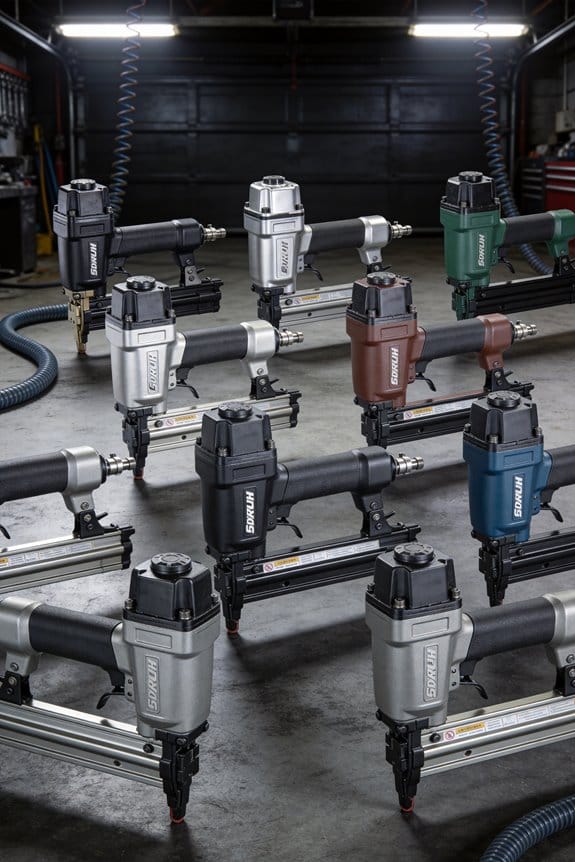
10 Best Nail Gun for Framing That Pros Reach For on Job Sites

You’re up on a scissor lift at dawn, trying to sink a stubborn 3¼” fastener through doubled top plates while sweat trickles into your eyes and every missed drive means climbing down to fix it.
On the job site, that one misfire or a tool that keeps gouging studs turns a two-hour wall into a day-long fight.
What separates a reliable tool from a headache are power and consistency, balanced with weight and ease of depth adjustment — buyers often pick based on brand alone, the wrong nail angle, or ignore drive mode and ergonomics.
This guide gives you 10 top framing nailers chosen for drive consistency, weight, ergonomics, depth control, and fastener availability; by the end you’ll know which models suit long runs, tight spaces, or cordless mobility.
Key Takeaways
If you work on tight jobsite corners and want nails that actually fit where you need them, pick a 21°–30° framing nailer so the magazine matches common nail collations and gives you better access in confined spots. For anyone who hates hauling a compressor around, go cordless (battery or fuel) for true mobility and no compressor dependency, while pneumatic models keep running as long as you have air. What makes this framing tool stand out for long days is a 7–11 lb weight range with centered balance, a non-slip grip, and adjustable depth so your arms don’t wear out and your nails sit flush. You get selectable firing modes like sequential and bump, tool-free depth adjustment, and a quick-clear nose for faster work and safer jams without fiddling. The framing gun you rely on should have a magnesium or aluminum body with hardened claws and a dry-fire lockout, plus a solid warranty so the tool stays tough on the job.
| Metabo HPT NR90AES1 21° Framing Nailer |  | Balanced Performer | Nail Angle: 21° | Power Source: Pneumatic (air-powered) | Compatible Nail Length: 2″ to 3-1/2″ | VIEW LATEST PRICE | Read Our Analysis |
| CRAFTSMAN V20 Cordless 21° Framing Nailer (Bare) |  | Cordless Convenience | Nail Angle: 21° | Power Source: Cordless battery (20V brushless) | Compatible Nail Length: up to 3-1/4″ (stated up to 3-1/4″; description also says up to 3-1/4 or 3-1/4) | VIEW LATEST PRICE | Read Our Analysis |
| BOSTITCH Pneumatic Framing Nailer F21PL (Round Head) |  | Heavy-Duty Pneumatic | Nail Angle: 21° | Power Source: Pneumatic (air-powered) | Compatible Nail Length: 2.0″–3.5″ (plastic-collated) | VIEW LATEST PRICE | Read Our Analysis |
| VEVOR Pneumatic Framing Nailer 2″–3.5″ (21°) |  | Budget Workhorse | Nail Angle: 21° | Power Source: Pneumatic (air-powered) | Compatible Nail Length: 2″–3.5″ | VIEW LATEST PRICE | Read Our Analysis |
| PneuTools SN2283H 21 Degree Framing Nailer with Rafter Hook |  | Contractor Favorite | Nail Angle: 21° | Power Source: Pneumatic (air-powered) | Compatible Nail Length: 2.0″–3.5″ | VIEW LATEST PRICE | Read Our Analysis |
| 20V 30DEG FRAMING NAILER BARE |  | High-Power Cordless | Nail Angle: 30° (note: differs but is a framing nailer in roundup) | Power Source: Battery (20V) — bare tool | Compatible Nail Length: (30° model) — framing nails (30° system) — drives typical 30° framing nails (2″–3‑1/2″ class implied) | VIEW LATEST PRICE | Read Our Analysis |
| 3PLUS H2190SP 21 Degree Full Round Head Framing Nailer |  | Feature-Packed Pro | Nail Angle: 21° | Power Source: Pneumatic (air-powered) | Compatible Nail Length: 2.0″ to 3.5″ | VIEW LATEST PRICE | Read Our Analysis |
| Paslode Cordless Xpro 30° Framing Nailer |  | Lightweight Cordless | Nail Angle: 30° (Paslode XPro) | Power Source: Cordless (battery + fuel cell) | Compatible Nail Length: 2″ to 3-1/4″ | VIEW LATEST PRICE | Read Our Analysis |
| BHTOP 9021NS 21° Framing Air Nailer |  | Durable Magnesium Build | Nail Angle: 21° | Power Source: Pneumatic (air-powered) | Compatible Nail Length: 2″ to 3-1/4″ / up to 3-1/2″ (mixed listing) | VIEW LATEST PRICE | Read Our Analysis |
| KingOu NR2183 21° Aluminum Pneumatic Framing Nailer | Value Professional | Nail Angle: 21° | Power Source: Pneumatic (air-powered) | Compatible Nail Length: 2.0″ up to 3.25″ | VIEW LATEST PRICE | Read Our Analysis |
More Details on Our Top Picks
Metabo HPT NR90AES1 21° Framing Nailer
If you’re framing in tight corners and need nails to sit compactly, the 21° magazine angle keeps strips snug so you can get into tight spots. That angle also makes loading and maneuvering on ladders easier.
For anyone who switches between careful layout work and fast-paced nailing, the switchable actuation lets you pick sequential mode for controlled shots or contact mode when you need speed. It’s handy when you move between precision tasks and running rafters.
What makes this pneumatic nailer stand out is the tool-less depth adjustment that lets you set nails flush or countersunk across different materials. It’s quick to dial in and saves time on trim and framing jobs.
You get a balanced 7.5 lb body without a heavy feeling in your hands, so your arms stay less tired during long days. That weight helps if you’re carrying the tool up and down scaffolding.
The Metabo HPT NR90AES1 solves the problem of compatibility by taking 2″ to 3-1/2″ plastic-collated nails, which covers the sizes you’ll use most on framing and sheathing. It’s reliable for both pros and serious DIYers.
Perfect for busy job sites, it ships with safety glasses and comes with a five-year professional warranty that supports your purchase. You’ll appreciate having that backing when you put the tool through regular use.
- Nail Angle:21°
- Power Source:Pneumatic (air-powered)
- Compatible Nail Length:2″ to 3-1/2″
- Trigger/Fire Modes:Sequential and contact (switchable)
- Weight (approximate):7.5 lbs
- Depth Adjustment:Tool-less depth adjustment
- Additional Feature:Selectable actuation mode
- Additional Feature:Redesigned head guard
- Additional Feature:Includes safety glasses
CRAFTSMAN V20 Cordless 21° Framing Nailer (Bare)
If you need to drive long nails into dense lumber without dragging an air compressor around, the 20-volt brushless motor sinks up to 3-1/4-inch round-head, plastic-collated nails into laminated veneer lumber and other tough wood. It gives you cordless power and real jobsite mobility.
For anyone who likes to tweak outcomes on the fly, the tool-free depth adjustment lets you set nail depth quickly so you don’t overdrive or leave nails proud. The rafter hook keeps the nailer within reach when you’re moving around a roof or ladder.
What makes this framing nailer stand out for V20 users is that it’s a bare tool, so you can use your existing V20 batteries and charger with other Craftsman gear. You’ll need to supply the battery and charger yourself.
You get peace of mind with a three-year limited warranty backing the unit, which helps if you run into defects or early failures. It’s a solid pick if you want cordless convenience and strong driving power.
- Nail Angle:21°
- Power Source:Cordless battery (20V brushless)
- Compatible Nail Length:up to 3-1/4″ (stated up to 3-1/4″; description also says up to 3-1/4 or 3-1/4)
- Trigger/Fire Modes:Not explicitly stated; typical modes implied (sequential/bump capability not specified)
- Weight (approximate):10.75 lbs
- Depth Adjustment:Tool-free depth adjustment
- Additional Feature:20V brushless motor
- Additional Feature:Rafter hook included
- Additional Feature:No compressor needed
BOSTITCH Pneumatic Framing Nailer F21PL (Round Head)
If you need a nailer that switches between framing and connector work without fuss, the quick-change nosepieces let you flip from plastic-collated framing nails to metal connector nails in seconds, so you can keep your job moving. The F21PL has a 21-degree magazine that holds up to 60 nails and runs on standard shop air, and it delivers 1,050 in./lbs. of driving power for framing, sheathing, or connector work. Nice power.
For anyone who wants a tool that won’t wear you out on the jobsite, the magnesium body keeps the weight near 8.15 pounds so you can use it all day with less fatigue. There’s a push-button depth guide that sets a consistent countersink depth for every nail, which helps your trim and sheathing look cleaner. Handy feature.
What makes this framing nailer stand out for busy builders is the printed 16-inch layout and adjustable rafter hook that speed up layout and placement on rafters and studs. You also get wear guards for the parts that take the most abuse, so the tool holds up under regular use. Peace of mind.
You get long-term support with a seven-year warranty, which lets you focus on the job instead of worrying about defects. If you’re a contractor, remodeler, or serious DIYer who needs a versatile, heavy-duty pneumatic nailer, this is a smart pick.
- Nail Angle:21°
- Power Source:Pneumatic (air-powered)
- Compatible Nail Length:2.0″–3.5″ (plastic-collated)
- Trigger/Fire Modes:Sequential or bump (smart trigger)
- Weight (approximate):8.1–8.15 lbs
- Depth Adjustment:Push-button adjustable depth guide
- Additional Feature:Two quick-change nosepieces
- Additional Feature:Magnesium body construction
- Additional Feature:16″ layout indicator
VEVOR Pneumatic Framing Nailer 2″–3.5″ (21°)
If you’re framing a deck or building a roof and need a nailer that keeps up, this tool handles 2″–3.5″ full round head nails so you won’t waste time swapping sizes. It takes smooth, ring, and threaded shanks and holds up to 60 nails in the aluminum magazine, which keeps your workflow moving. Fast refill.
For anyone who wants both precision and speed on the job, the 80–120 PSI range and selectable sequential or bump firing give you control for exact placement and a faster pace when you need it. The tool-free depth wheel helps you set nail depth quickly, and the open nose design makes clearing jams simpler. Easy to adjust.
What makes this pneumatic framing nailer stand out for long days on site is the ergonomic grip and compact body that cut down on hand fatigue. You still get the power for heavy framing without lugging around something bulky. Comfortable feel.
You get durable performance without complicated maintenance because the aluminum magazine is light and the simple controls are straightforward to use. That combination makes it a good pick whether you’re a professional carpenter or a serious DIYer tackling big projects. Good value.
- Nail Angle:21°
- Power Source:Pneumatic (air-powered)
- Compatible Nail Length:2″–3.5″
- Trigger/Fire Modes:Sequential and contact (switchable)
- Weight (approximate):9.04 lbs
- Depth Adjustment:Tool-free hand-turn depth adjustment wheel
- Additional Feature:Open-nose jam clearing
- Additional Feature:Aluminum magazine
- Additional Feature:Ergonomic anti-slip grip
PneuTools SN2283H 21 Degree Framing Nailer with Rafter Hook
If you’re doing heavy framing and need something that keeps up, the 21° plastic-collated design accepts standard framing nails so you don’t have to hunt for special fasteners. It has a full round head that holds nails securely for strong connections. Short and simple.
For anyone who spends long days on a roof or in a framing crew, the rafter hook keeps the nailer within reach on a beam so you won’t slow down climbing up and down ladders. The pneumatic drive gives repeated driving force without batteries, which is handy when you’re working far from power. It’s built tough for jobsite use.
What makes this framing nailer stand out is the one-piece safety mechanism and hardened end cap that help the tool keep performing hit after hit. The precision-manufactured body feels solid in your hands and helps with consistent performance. Light and dependable.
You get a simple, single-mode low-profile trigger that makes firing straightforward and reduces fumbling in tight spots. It’s a no-frills control that most pros will appreciate for speed and predictability. Quick to use.
The PneuTools SN2283H solves the problem of heavy, awkward tools by tipping the scale at about 10.5 pounds, which balances power and manageability on long jobs. It ships in a compact package and comes with manufacturer warranty options to give you some coverage for trouble. Small package, big results.
- Nail Angle:21°
- Power Source:Pneumatic (air-powered)
- Compatible Nail Length:2.0″–3.5″
- Trigger/Fire Modes:Single-mode (low-profile) — primarily single/standard actuation (has safety mechanism)
- Weight (approximate):10.53 lbs
- Depth Adjustment:(Tool summary: depth adjustment not explicitly listed) — standard framing nailer (tool implies depth control)
- Additional Feature:Rafter hook included
- Additional Feature:Hardened end cap
- Additional Feature:Single-mode low-profile trigger
20V 30DEG FRAMING NAILER BARE
If you need a cordless nailer for jobs where an air compressor isn’t practical, the 20V battery delivers the power to sink framing nails without a hose getting in your way, and the tool’s 9.9-pound weight keeps it manageable during long days. The 30° angled magazine helps you work in tight corners and between studs, which is handy when you’re framing in cramped spaces. It’s compact.
For anyone who wants to avoid lugging compressor gear around, the nailer ships bare so you can pair it with the DeWalt battery platform you already own or choose the capacity that matches your workload. You’ll want batteries and a charger if you don’t already have them.
What makes this cordless framing nailer stand out is the size and shape: at about 13.9 x 5.6 x 13.2 inches, it tucks into a tool belt or van without taking up much room, so you can keep it handy between cuts. The brush-finished build feels tough on the jobsite and comes with DeWalt’s manufacturer warranty for peace of mind. It’s easy to handle.
You get quick setup and fewer trips to a compressor when you frame with this tool, and the 30° magazine accepts a common range of coil nails so you won’t be hunting for obscure fasteners. Expect solid driving for typical framing, shear walls, and truss work. It performs reliably.
- Nail Angle:30° (note: differs but is a framing nailer in roundup)
- Power Source:Battery (20V) — bare tool
- Compatible Nail Length:(30° model) — framing nails (30° system) — drives typical 30° framing nails (2″–3‑1/2″ class implied)
- Trigger/Fire Modes:Not specified in summary (standard framing nailer features)
- Weight (approximate):9.9 lbs
- Depth Adjustment:(Not explicitly stated) — typical framing nailer features (tool likely includes depth adjustment)
- Additional Feature:30° magazine angle
- Additional Feature:DeWalt model DCN930B
- Additional Feature:Bare tool only
3PLUS H2190SP 21 Degree Full Round Head Framing Nailer
If you need a nailer that can handle framing and structural work, the 21° full round head capacity and 2.0–3.5 inch nail range mean you can drive the common sizes pros use. It handles long nails without fuss, and you’ll spend less time swapping tools.
For anyone who wants consistent drives without fiddling with tools, the tool-free depth adjustment gives you precise flush or countersunk nails every time. It’s quick to change and keeps your work looking clean.
What makes this framing nailer stand out for jobsite longevity is the dry-fire lockout that stops the nailer from firing when it’s empty, which prevents missed nails and reduces wear. That feature protects your workflow and saves you from frustrating jam checks.
You get comfort and surface protection without sacrificing control thanks to the 360° exhaust and no-mar tip that keep your workpiece from getting scratched. The tip also helps when you’re working on finished surfaces.
The 3PLUS H2190SP solves wear-at-the-nose issues by using a hardened claw, which resists damage during toe-nailing and heavy use. You’ll notice less nose wear over time compared with softer components.
Perfect for framers or serious DIYers, this nailer offers both sequential and bump firing so you can choose the mode that fits your task and skill level. Pick sequential for precision and bump for speed.
If you care about a tool that feels solid in your hands, the aluminum-and-steel construction gives you a strong build at about 10.7 pounds. It’s heavy enough to feel durable but still manageable on long jobs.
- Nail Angle:21°
- Power Source:Pneumatic (air-powered)
- Compatible Nail Length:2.0″ to 3.5″
- Trigger/Fire Modes:Sequential and bump (two-mode switch)
- Weight (approximate):10.69 lbs
- Depth Adjustment:Tool-free depth adjustment
- Additional Feature:360° exhaust cover
- Additional Feature:No-mar tip
- Additional Feature:Dry-fire lockout
Paslode Cordless Xpro 30° Framing Nailer
If you need to move around a job site without dragging a compressor and hose, this nailer gives you cordless convenience with battery-and-fuel-cell power that still drives full-size framing nails. It drives 2 to 3-1/4 inch 30° nails flush into hard lumber, so your framing and sheathing go in cleanly and quickly. Work longer with less arm fatigue.
For anyone who tires of heavy tools, the XPro weighs just 7.9 pounds, making it one of the lightest cordless framing nailers you can carry all day. You get about 6,000 shots per charge so you can finish long stretches of framing before swapping power. It comes with a hard case, charger, and battery so you’re ready on day one.
What makes this framing nailer stand out for busy pros and DIYers alike is the mix of power and portability — it’s compressor-free yet drives full-size nails into tough materials. You can choose sequential or bump-fire actuation depending on the job and your comfort level. It’s practical and user-friendly.
- Nail Angle:30° (Paslode XPro)
- Power Source:Cordless (battery + fuel cell)
- Compatible Nail Length:2″ to 3-1/4″
- Trigger/Fire Modes:Sequential or bump-fire (user selectable)
- Weight (approximate):7.9 lbs
- Depth Adjustment:Drives flush — depth control implied (capable of flush driving; typical adjustable settings)
- Additional Feature:Battery + fuel cell
- Additional Feature:6,000 shots per charge
- Additional Feature:Comes with hard case
BHTOP 9021NS 21° Framing Air Nailer
If you’re doing regular framing work and want something light that won’t tire your arm, the BHTOP 9021NS gives you a magnesium body that keeps weight down while still feeling solid in your hand. For anyone who needs consistent driving power on site, the 21° magazine accepts plastic-collated nails from 2″ to 3-1/4″ and lets you drive longer lengths when the job calls for it. What makes this framing nailer stand out for quick adjustments is the tool-less depth control, so you can change nail penetration without fumbling with tools. You get better grip and control without adding bulk thanks to the non-slip rubber handle. The BHTOP 9021NS solves jam headaches by using an open nose that clears nails fast, and a hardened claw helps when you need to toe-nail in tight spots. Perfect for users who run air tools all day, it runs on compressed air for steady power and requires the tip switch to be pressed before firing. Use it when you want a reliable, easy-to-handle framing nailer that’s built for regular site use. Short and simple.
- Nail Angle:21°
- Power Source:Pneumatic (air-powered)
- Compatible Nail Length:2″ to 3-1/4″ / up to 3-1/2″ (mixed listing)
- Trigger/Fire Modes:Quick-fire or single-shot (interchangeable trigger)
- Weight (approximate):11.97 lbs
- Depth Adjustment:Tool-less depth-of-drive adjustment
- Additional Feature:Interchangeable trigger modes
- Additional Feature:Magnesium body material
- Additional Feature:Hardened claw tip
KingOu NR2183 21° Aluminum Pneumatic Framing Nailer
If you need to frame a house fast without getting sore, the NR2183 fires quickly and keeps weight low so your arms don’t tire. It takes full-head, plastic-collated nails from 2.0 to 3.25 inches, which means you can use the common framing lengths you already buy. Short sentence.
For anyone who works long days on site and cares about tool weight, the 21° aluminum body with magnesium-alloy parts brings the mass down to about 10.9 pounds so you can swing all afternoon. The lighter build doesn’t cut power; this is a pneumatic tool that delivers consistent, rapid shots for high-output jobs. Short sentence.
What makes this framing nailer stand out for angled or tight nailing jobs is the reinforced claw tip and the good nose grip, so your nails stay true when toe-nailing. You also get interchangeable magazines that switch you between rapid feed and single-shot mode depending on the task, which speeds up big jobs. Short sentence.
You get a tool that feels more comfortable over a full workday without sacrificing productivity, because the combo of low weight and steady pneumatic fire rate keeps pace with crew work. If you want something suited to framers, remodelers, or anyone hauling lumber and sheathing, this one is built for that kind of repeat use. Short sentence.
- Nail Angle:21°
- Power Source:Pneumatic (air-powered)
- Compatible Nail Length:2.0″ up to 3.25″
- Trigger/Fire Modes:Interchangeable magazine clips for fast-shooting or single-shot function (implies selectable fire modes)
- Weight (approximate):10.88 lbs
- Depth Adjustment:(Not explicitly stated) — described as easy to operate and lightweight; typical framing nailer depth control implied
- Additional Feature:Aluminum/magnesium alloy body
- Additional Feature:Interchangeable magazine clips
- Additional Feature:Reinforced claw tips
Factors to Consider When Choosing a Nail Gun for Framing
If you need long hours on a jobsite without stopping, pick the power source first because pneumatic, cordless battery, and gas models change runtime, convenience, and how consistently nails drive. Pneumatic tools keep running with an air hose but tie you to a compressor, cordless gives you freedom and less setup but needs charged batteries, and gas models trade a small fuel cell for fewer hose tangles. Consider the nail angle next since the magazine angle limits what nails you can use and affects how the tool fits tight corners. For precise work you want drive depth control so you can set nails to sit flush or just below the surface for a clean finish. For longer days think about weight and balance because a well-balanced, lighter tool reduces arm fatigue and lets you work more comfortably. Also look at how easy the tool is to maintain and how tough its components are, since fewer service visits mean more time working.
Power Source Type
If you need long runs with steady power on big framing jobs, pneumatic nailers give the driving force you want and handle repeated shots without fading; you will need an air compressor, hoses, and fittings that add setup and upkeep. They deliver consistent punch for busy crews.
For anyone who hates dragging hoses around smaller sites, cordless battery nailers free you from tethers and make moving between tasks fast, and you should match battery voltage and capacity to your daily workload so you don’t run out mid-day. They make solo work smoother.
What makes this power-source category stand out for heavy-duty solo or remote work is fuel-cell cordless tools, which bring high power and long runtime without hoses, but plan on recurring fuel cartridge purchases that raise operating costs over time. They feel like a gas tool without the smell.
You get compactness without a big setup when choosing manual or powder-actuated tools for specialty tasks, though they’re limited in framing versatility and might require training or permits. Use them for tight spots or specific fastening needs.
The right choice balances mobility, shot count, driving power, and supply logistics so your tool matches how you work and where you work. Think about what you do every day before you pick one.
Nail Angle Compatibility
If you’re working in tight framing spots and need a nailer that fits into cramped angles, nail angle compatibility matters because it determines what collated nails will work and how the tool maneuvers. For anyone who wants strong holding power for structural connections, lower angles around 21°–28° use full round-head nails, which typically give better pullout resistance and meet many connector or code requirements. What makes this choice practical for your workflow is that higher-angle guns accept clipped-head or offset-collated nails so manufacturers can pack more nails into the magazine, giving you better capacity when you don’t want to reload as often. You get easier access in tight corners without sacrificing how many fasteners you can carry. Perfect for framers who juggle space and supply, match the nail angle to the fasteners you can buy locally, any connector specs you must follow, and the real-world spots where you’ll be nailing.
Drive Depth Control
If you worry about split wood and nails that stick up, choose a nailer with tool-free depth adjustment so you can set nails flush or slightly countersunk without stopping work. The mechanism lets you dial or turn a screw to change depth on the fly, and that matters when softwoods, hardwoods, engineered lumber, and composites all need different nail seats. It prevents over-penetration that weakens joints and under-penetration that leaves nails proud.
For anyone who works long jobs and hates downtime, pick a model with settings that cover 2″–3½” nails and offer fine increments so you can make precise changes. The fine steps mean you won’t be guessing about whether a nail is sitting right. Look for controls tied to easy-access noseguards or maintenance features, since those keep performance steady.
Weight And Balance
If you’re working overhead for hours and want to avoid sore wrists, pick a framing nailer that’s light and well balanced, because lighter tools cut fatigue and make repetitive lifting easier. Choose models around 7–11 lbs so you can move faster in tight spaces and keep working longer without your arms burning. Test the balance yourself.
For anyone who handles a lot of nails each day and needs steady control, look for weight concentrated near the grip or center of mass, since that placement reduces wrist strain and lets you aim more accurately. A well-balanced gun feels like an extension of your hand, so you’ll drive straighter nails with less effort. Try it with a few dummy shots.
What makes this tool type stand out for tradespeople is the trade-off between weight and power: heavier nailers can deliver stronger driving force, which helps in dense materials, but they slow down repetitive work and tire you faster. Pick the capability that matches your job—heavy hitters for tough framing, lighter bodies for long runs of fast nailing. Don’t guess.
You get a realistic feel when you check balance with the magazine both loaded and unloaded, because a sudden forward or rearward shift changes comfort and can affect safety on the job. Swing the tool like you will on the jobsite to see if it stays steady. If it tilts, try a different model.
Maintenance And Durability
If you use a pneumatic tool every day and hate when it feels sluggish, plan for regular care from day one and your gun will keep feeling right. Clean and add a few drops of pneumatic tool oil to fittings and moving parts before you start; this prevents rust and keeps firing consistent. Short reminder: do that before each use.
For anyone who notices power drops or more jams, check the nose tips, driver blades, O-rings, and seals and swap worn parts quickly. Replace damaged pieces when you see air leaks or reduced performance. It saves you headaches later.
What makes this tool stand out for busy crews is a clean magazine and feed system, which keeps rounds moving smoothly under load. Look for dirt, bent springs, or corrosion and clear debris so you avoid misfeeds and double feeds. Little maintenance like that keeps your workflow steady.
You get better longevity without complicated steps by storing guns in dry, temperature-stable cases and using inline airline filters to remove moisture. Run only compatible, undamaged collated strips and you’ll cut down on jams and wasted time. Simple habits extend the tool’s useful life.
Frequently Asked Questions
Can I Use Framing Nailers for Metal Connectors and Hangers?
If you’re attaching joist hangers or metal straps and want speed, a framing nailer saves you time and cuts effort because it drives lots of nails fast and straight. Match the nail length and diameter to the connector’s spec so your hanger gets the full bite it needs. Use hot-dipped galvanized or stainless nails when you’re working in damp areas so the metal won’t corrode over time.
For anyone who worries about bent nails or shallow penetration, pick nails rated for metal connectors and adjust your nailer’s depth and pressure so each nail goes cleanly through the connector into the wood. Avoid nails that hit and bend or stop short of the member, and don’t force a setting that you can’t control. If you ever feel unsure about a particular connector, use approved connector screws or bolts instead.
What makes this fastener approach stand out is that it’s practical for most common hangers and connectors, letting you finish framing work faster without switching tools for every piece. Follow the hanger manufacturer’s instructions and local code requirements so your work holds up—and keeps inspectors happy. When conditions call for the highest connection strength, choose the connector’s recommended screws or bolts.
How Do Seasonal Temperatures Affect Cordless Nailer Battery Performance?
If you find your nailer dying faster in winter, cold cuts battery capacity and leaves you with fewer shots per charge, so expect shorter run time. Charge batteries at room temperature so you don’t start a job with a weak pack. For anyone who works in warm climates or leaves tools in a hot truck, heat will temporarily boost capacity but speeds chemical wear and shortens the battery’s overall lifespan, so don’t make a habit of it. Store batteries insulated when it’s freezing. What makes this cordless nailer stand out for busy job sites is that rotating spares and checking voltage under load keeps your day moving, and you can spot a tired battery before it ruins a finish. You get safer, more consistent performance without risking damage by following the manufacturer’s temperature limits. Perfect for weekend DIYers, this approach—charge smart, store warm when cold, and avoid hot cars—keeps your nailer reliable.
What Maintenance Schedule Prevents Premature Nailer Wear and Failures?
If you use a nailer every week on job sites, check the fastener feed and magazine weekly so jams don’t slow you down, and clean out debris while lightly oiling moving parts. For anyone who stores a nailer between jobs, keep batteries charged and stored properly to protect their lifespan. What makes this maintenance plan stand out is the monthly attention to seals and O‑rings: inspect them, replace worn components, and torque fasteners to spec to keep the tool sealing and firing reliably. You get peace of mind without big downtime when you log all maintenance for trend tracking. The nailer solves premature wear by scheduling an annual full teardown, replacing major wear parts, and test firing under load to catch problems early. Perfect for busy DIYers and pros, this routine is simple to follow and keeps your tool working.
Are Specialty Nails Required for Pressure-Treated Lumber?
If you’re building a deck or outdoor planters that will touch treated wood, you need nails that won’t rust fast because the chemicals in pressure-treated lumber speed up corrosion. Hot-dipped galvanized nails are affordable and give your project tough resistance for years, and stainless steel nails resist corrosion best if you want the longest-lasting option. For most DIY projects, coated nails hit a sweet spot between price and performance.
For anyone who plans to use a nail gun, pick nails that match your tool and the wood thickness so you don’t get jams or split boards. Choose length and head style for holding power — longer nails and ring-shanks grip better in structural or load-bearing pieces. If your build faces harsh exposure, go up a grade on the fastener.
What makes these fasteners practical is that you can match material to the environment: stainless for salt-air or high-moisture spots, galvanized for yard projects, and coated for general outdoor work. You’ll also want to check local building codes so your choice meets any exposure or structural requirements. Short sentence.
Can Framing Nailers Be Safely Used on Scaffolding or Ladders?
If you’re working on scaffolding or a ladder and need to drive a lot of nails fast, a framing nailer can save you time because it fires consistently and finishes studs quickly, but you’ll want to pay attention to safety. Hold the tool with both hands and keep your feet planted so recoil doesn’t throw you off balance. Be careful.
For anyone who climbs to reach rafters or upper walls, use fall protection and tether the tool so a slip won’t drop it; that keeps you and the crew safer while you work. Secure any hoses or fuel cells to your harness or scaffold rail so they don’t tangle underfoot and create a tripping hazard. Small things like a loose hose can cause big problems.
What makes this tool stand out for busy job sites is the speed it gives you on repetitive nailing tasks, but you should set nail depth and fastener type before you start so you don’t have to rework a section from above. Check the depth on a scrap piece first and adjust the driver if nails sit proud or sink too deep. Don’t skimp on that step.
You get the benefit of finishing a framing run faster without risking a solo accident by not working alone at height when using pneumatic or gas nailers. Bring a helper to pass materials, watch your footing, and manage lines; two people reduce the chance of a fall or dropped tool. Simple teamwork helps.
Perfect for DIYers and pros who move quickly between elevated positions, a framing nailer will help you get framing done if you respect its power and follow basic precautions. Treat it like a powerful tool: firm grip, checked settings, secured lines, and fall protection. Stay safe.